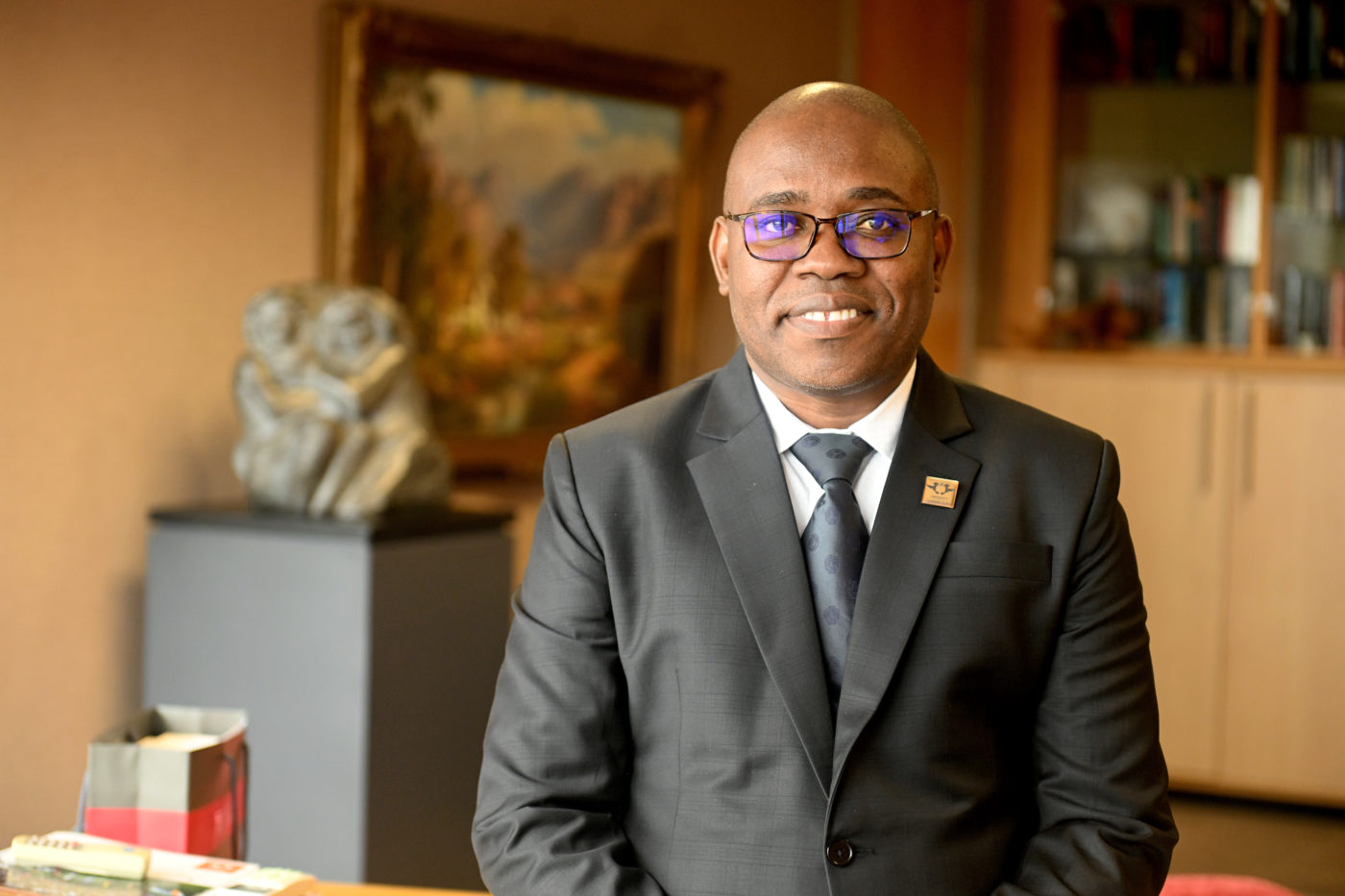
Thousands of years ago, kings appointed accountants to keep track of food reserves. As people brought grain to the royal storage facilities, accountants recorded the transactions on papyrus, or clay tablets. In the age of AI, the accounting profession still faces the questions asked in ancient times, says Professor Gideon Els from the University of Johannesburg (UJ).

“Who is accountable, to whom, for what? The ledger has always posed this question. To the merchant who owed a debt and the steward who managed someone else’s estate. To the corporation that claimed to act in shareholders’ interests. Also, to the government that spent public funds,” says Prof Els.
He was speaking at his professorial inauguration on Wednesday 22 July, at the UJ Kingsway Campus.
Prof Els is a researcher and lecturer in the Department of Accountancy within the School of Accounting, and the UJ College of Business and Economics.
As a child, the visual order of accounting tests appealed to him.
“My father was an accounting teacher for many years. As a young boy I often watched him marking accounting tests and examinations at home. Pages and pages of learners’ answers written on beautifully ruled paper.
“When I entered high school and took Accounting as a subject, I encountered a general ledger for the first time. Pages with a left and a right side – for the debit and credit side. I remember the sensation of writing on it. The discipline it imposed, satisfaction, and a bit of relief when the debit side equalled the credit side.
“What I did not know then was that the ledger was also asking a question,” he says.
Years later, the neatness of numbers collided with the reality of a business in his research.
He had everything a quantitative study should have: a dataset and a good research design. But the phenomenon he was studying refused to be captured by the numbers. “The numbers left out everything that anyone inside the organisation cared about,” he says.
So he conducted the research firsthand. The fieldwork revealed what the numbers could not: the people on the ground weren’t using the accounting system as designed. They were reshaping it, pushing back against it, and sometimes working around it in ways the statistical model was blind to.
“That discovery changed how I thought about what accounting research was for,” he says.

Since then, Prof Els started focusing on the social consequences of accounting practices. These are shifting with the rise of social and environmental accounting. Sustainability reporting itself is shifting from something firms could choose to do, to something they are required to do, he says.
Enduring questions about accounting now have a new form. Do global sustainability standards actually hold companies accountable? Or do they just help corporations to look good? They can also be a way to exert cultural and economic power on the less powerful. Postcolonial scholars point out that the heaviest burdens often fall on those who were already left behind by global financial markets, he explains.
The recent rise of Artificial Intelligence (AI) is testing accountancy even further.
“Machine learning (ML) can identify patterns in financial data that human analysts would miss,” he says.
Natural Language Processing (NLP) can pull data from written documents on a massive scale. It completely changes what historical research can achieve. However, putting bad data into a computer still gives you bad results. Only now it happens faster than ever but still looks convincing, he adds.
“The automated systems used to decide who gets loans, credit, or insurance, are not without bias. Instead, they build in personal biases from their developers, making existing inequalities worse. They seem so exact that they trick us into thinking they are completely objective,“ he says.
The bigger question is whether shifting into AI technology will make accounting wiser. Not just faster or stronger, but truly wiser, he asks.
“I have spent my career learning to ask expert questions. The questions that require human context, experience, and judgement. These are the questions algorithms cannot answer by themselves,” he says.
Going forward, Prof Els plans to pursue AI-augmented research design, using computational methods. These allow researchers to work at a scale and speed that was not available to earlier generations.
“The most urgent task is carbon accounting for the move to net zero, but this is very difficult to do. Counting emissions across a complex global supply chain is one example. Another is valuing natural capital, such as wild bees pollinating nearby farmland or the carbon stored by an ancient peatland. These have no market price”, he adds.
Prof Els returns to where he began, the ledger. “The accounting profession exists because accountability matters. The capacity to render economic activity transparent and to assign responsibility for its consequences is a social good,” he says.
“The ledger I first encountered was a tool for recording what had happened. The research agenda I am proposing is a tool for questioning whether we are recording what matters.”