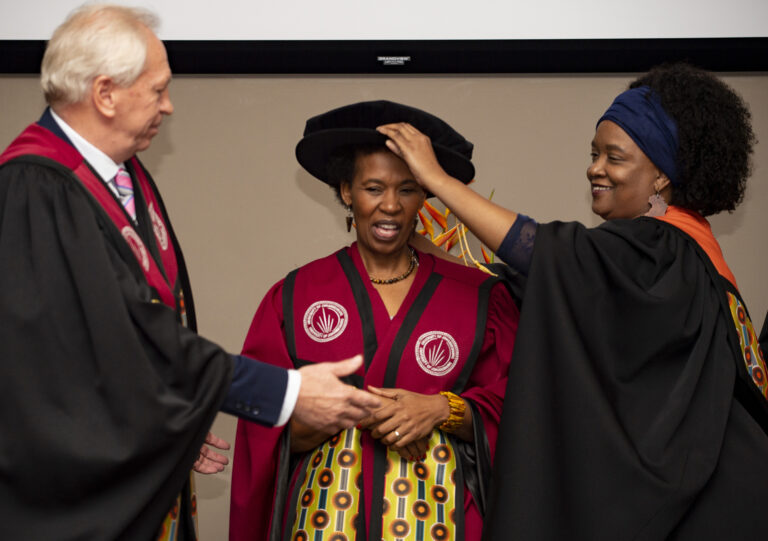
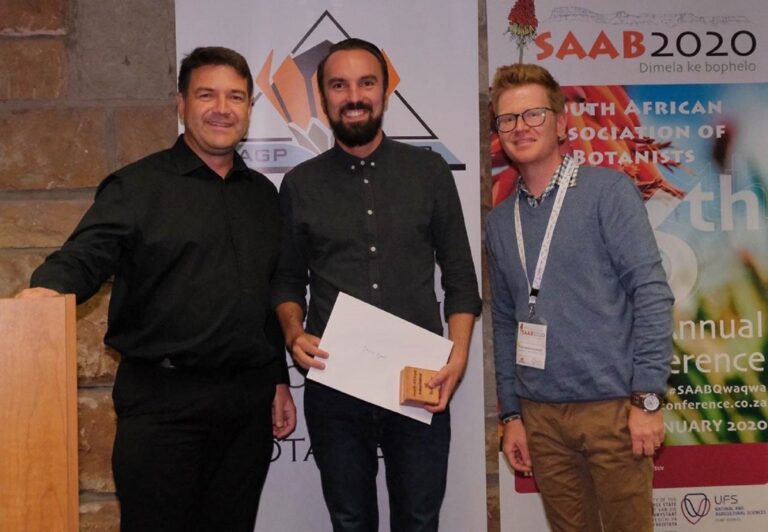
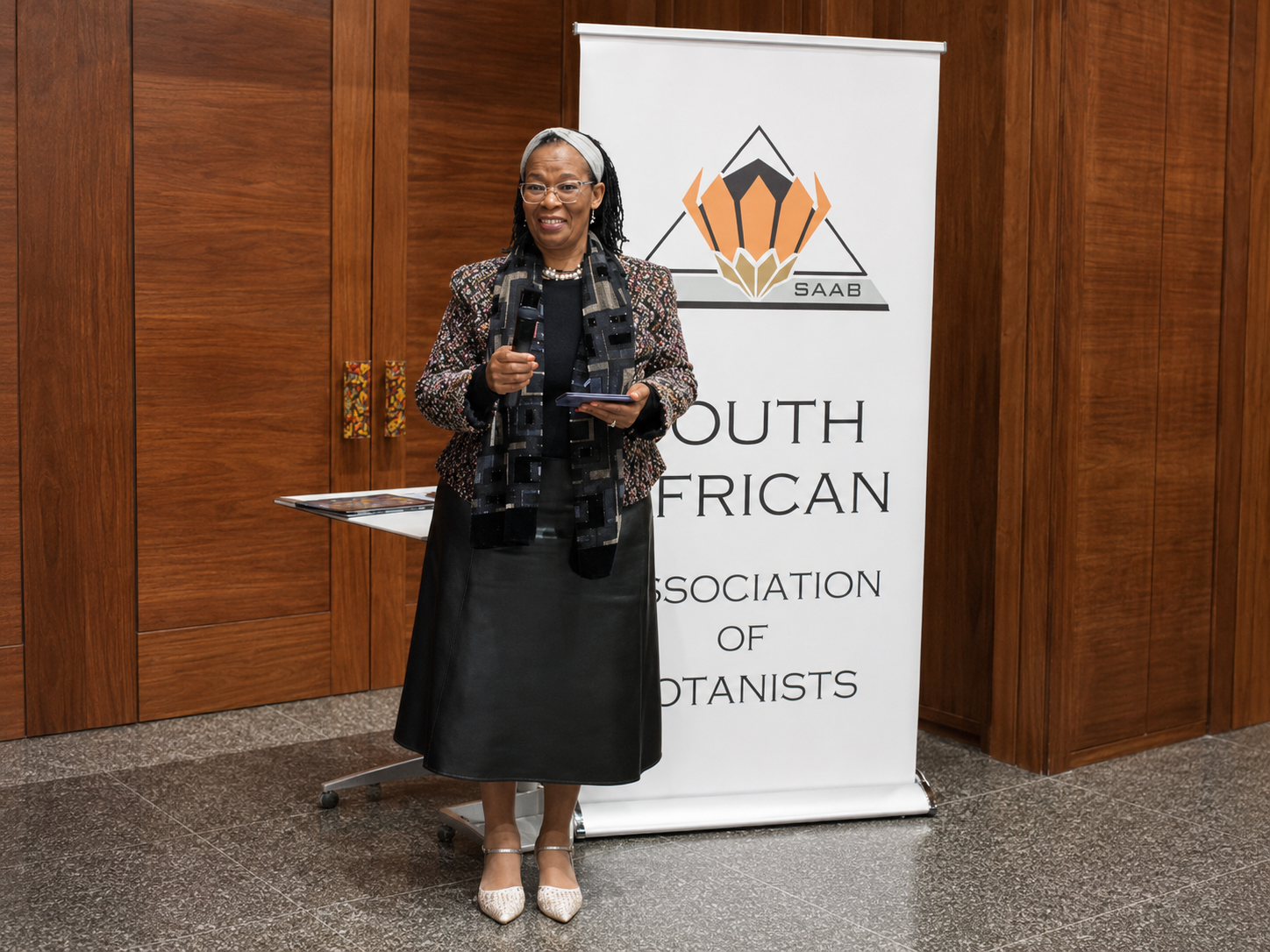
The University of Johannesburg (UJ)’s Professor Annah Moteetee was awarded the prestigious South African Association of Botanists (SAAB) Silver Medal.
Professor Moteetee, who is currently the executive dean of the Faculty of Science at UJ received this honour during the association’s 51st conference gala dinner held earlier this month.
She has dedicated her career to understanding, classifying, and preserving Southern Africa’s rich botanical heritage. The Silver Medal stands as a profound testament to a lifetime of research, indigenous knowledge preservation, and academic mentorship.
“The Silver Medal is a great honour because it means my fellow botanists have recognised my work as having made a meaningful contribution to advancing botany in South Africa,” says Prof. Moteetee. “It recognises a lifetime of commitment rather than a single achievement, which makes it especially rewarding.”
Prof. Moteetee’s journey into the intricate world of plant taxonomy (the science of naming, describing, and classifying plants) didn’t begin as an obvious path, it started with a challenge.
After completing her first degree, she was offered a position as a teaching assistant and was expected to teach plant taxonomy once she completed her master’s degree.
“It was a subject I initially found very challenging,” she reflects. “In mastering it, I discovered that accurate plant identification is the foundation of all botanical research; getting a plant’s name right unlocks everything else we can learn about it.”
That single realisation became the core of her scientific vision: using precise taxonomy to showcase the immense value of South Africa’s indigenous flora.
The SAAB Silver Medal highlights three core contributions that have defined Prof. Moteetee’s career namely; resolving plant taxonomies, preserving indigenous knowledge and mentoring future scientists. Her research has helped clarify complex classifications within southern African plant groups, most notably in the legume family, giving botanists nationwide a far more reliable scientific foundation.
“I have worked extensively to document how Basotho communities utilize local plants for medicine, food, and daily life, bridging traditional wisdom with modern scientific inquiry,” she said.
Additionally, guiding postgraduate students has remained one of her most cherished roles, ensuring the discipline thrives for generations to come.
On being a member of the SAAB, Prof Moteetee shared that it helps her remain on the pulse of important evolutions within the botany world, but also to belong to a community that provides important professional relationships and support.
“Being part of the association is equally important because it connects botanists who share a common purpose,” Prof. Moteetee explains. “It provides opportunities to collaborate, exchange knowledge, and support one another, while giving us a collective voice to promote the importance of plant science in conserving biodiversity and developing sustainable solutions for South Africa’s future.”
Winning a lifetime achievement award isn’t a signal to slow down. Looking to the future, Prof. Moteetee remains focused on bridging academia and eco-friendly agricultural practices.
Her active research pipeline explores plant-based insecticides, testing indigenous plant species that hold natural pest-control properties. Her objective is to build rigorous scientific evidence to develop safe, environmentally friendly alternatives to synthetic chemical pesticides for farmers and gardeners alike.
As researcher, Professor Moteetee is an established voice which has supervised 44 postgraduate students. She has authored and co-authored over 70 journal articles and contributed to over sixty national and international podium and poster presentations. She holds a C2 NRF rating and a Google Scholar h-Index of 21.
Alongside her research, mentorship remains central to her vision: “My main goals are to continue training the next generation of botanists and to advance my research on plant-based insecticides. I will keep mentoring postgraduate students because developing skilled plant scientists is essential for the future of botany.”