Dear UJ community,
In his book, Brave Companions: Portraits in History, award-winning American historian and author David McCullough reminds us that knowing our origins and past struggles is essential because history and memory give shape to personal identity, moral compass, and future direction. He writes: “How can we know who we are and where we are going if we don’t know anything about where we have come from and what we have been through, the courage shown, the costs paid, to be where we are?” I was reminded of McCullough’s words yesterday when we hosted one of our university’s flagship events.
2025 Stakeholder Report Launch
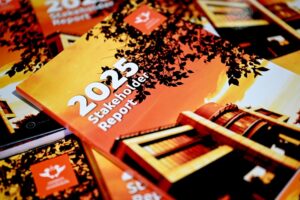
Yesterday, we hosted the 2025 Stakeholder Report Launch, an important event on our University’s calendar that provided a comprehensive overview of the University’s achievements and progress across the institution for the year under review. Lest we forget, 2025 was a milestone year for UJ, as the University celebrated its 20th anniversary and entered full implementation of its Strategic Plan 2035.
It was a year of reflecting on the University’s legacy while looking ahead, building on two decades of achievement and positioning UJ for its next chapter. Yesterday’s launch event featured a keynote address by Professor Somadoda Fikeni, Chairperson of the Public Service Commission, titled “The Role of the University in Building State Capacity.”
UJ’s chair of Council, Dr Yondela Ndema, provided a frank and robust assessment of UJ’s performance, reminding us of some of last year’s achievements. It was another year in which global rankings reaffirmed our standing as a leading University in South Africa and across the African continent in various disciplines.
Through strategic partnerships, research collaboration, and international engagement, UJ continues to enhance its standing while remaining firmly rooted in the African context. As the Chair of Council succinctly put it, the University has matured with resilience and ambition, moving from a focus on stabilisation and identity formation to one of strategic differentiation, global competitiveness, and meaningful societal engagement. While a lot of success has been achieved, enduring challenges remain, such as student financing, infrastructure development and staff and student well-being.
I thank Professor Bongani Ngqulunga and his team in the University Relations Division for ensuring that the event was a success. I also thank our University Registrar, Prof Bettine Van Vuuren, and everyone who contributed to the compilation of the Annual Report, from which the Stakeholder Report was developed. Read more here. You may also download the report here.
UJ Insight Magazine Joburg 140th Anniversary Edition
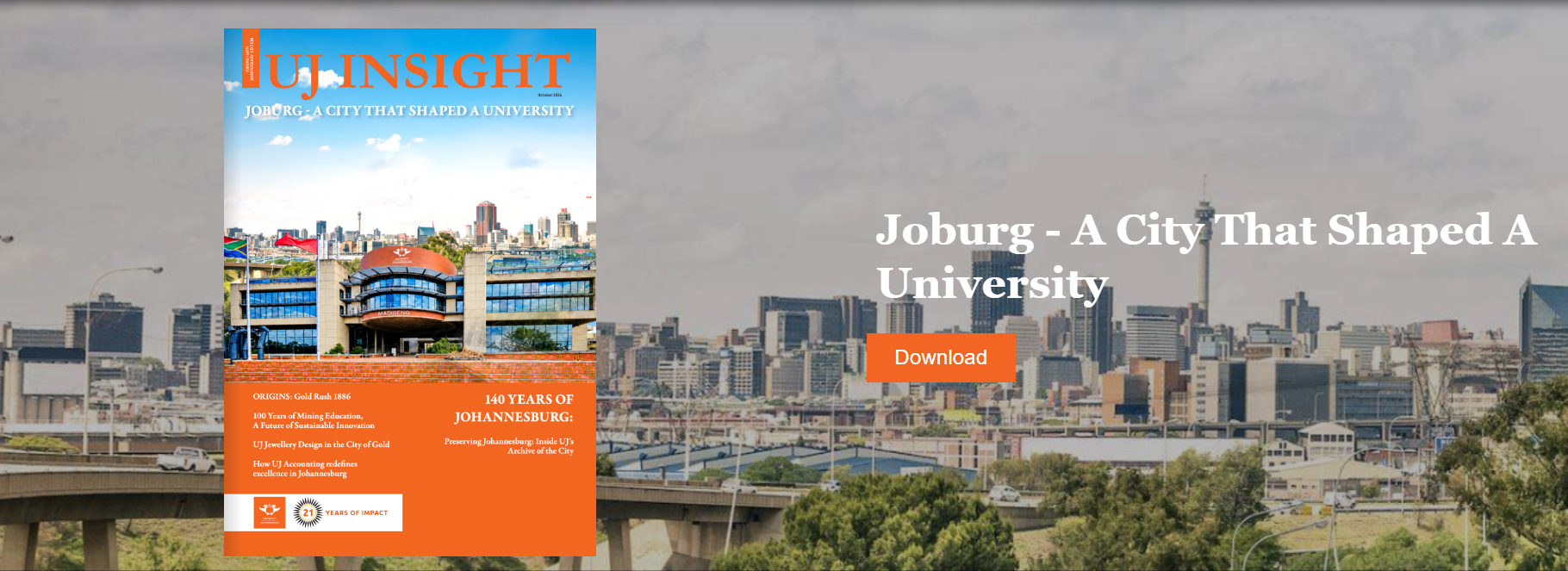
As Johannesburg celebrates its 140th anniversary this year, I am pleased to announce that the University of Johannesburg has released a special edition of its UJ Insight magazine to mark this milestone. The magazine explores the enduring relationship between the City of Gold and the University that carries its name. From a tented mining camp on the Witwatersrand in 1886 to Africa’s economic powerhouse, Johannesburg has shaped UJ’s identity – while UJ has, in turn, contributed to the city’s growth and development.
The edition traces more than a century of mining education and highlights UJ’s contributions to engineering, accounting, business, and the sciences, alongside research and partnerships that make a tangible difference in Johannesburg. These include work to restore the Klip River, collaborations with Jozi My Jozi and the Gauteng Department of Community Safety, and innovative AR and VR projects bringing the histories of Sophiatown and Melville Koppies to life. At its heart, the edition celebrates the people who preserve, study and shape the city – from archivists and academics to professionals and students. You can read the magazine here.
UJ achieves an unprecedented cumulative number of 389 NRF-rated researchers
With the recent rating outcomes, UJ has achieved an unprecedented total of 389 rated researchers from the National Research Foundation (NRF) of South Africa. We now have nine (9) A-rated researchers. An NRF A-rated researcher is a leading international scholar who is unequivocally recognised by peers as a world leader in their field of research. The A-rating comprises two sub-categories: A1 researchers (recognised universally by their peers for maintaining a high-quality, wide international impact on their field and A2 researchers (recognised by the overwhelming majority of reviewers for the wide or confined impact of their recent research).
Recently, six top UJ researchers were awarded ‘B’ ratings, which are given to researchers whose recent research outputs demonstrate a high level of quality and impact. In addition, the researchers are internationally recognised by their peers. This brings the total number of B-rated researchers in the institution to 73. The researchers are Prof David Bilchitz from the Faculty of Law; Professors Soebur Razzaque and Andre Strydom from the Faculty of Science; Salim Vally and Shireen Motala from the Faculty of Education; and Peter Olubambi from the Faculty of Engineering and the Built Environment. Click here to read more about this.
UJ expands its number of scientists rated among the World’s Top 2%
I am pleased to share that UJ’s top 2 per scientists has expanded, and thus UJ’s global footprint and societal impact continues to grow. This is due to our University attracting and developing top talent in their fields of specialisation, whose research is among the most highly cited in the world. The annual global list identifies the world’s most influential scientific minds based on comprehensive and standardised citation data drawn from Elsevier’s Scopus database and analysed by Stanford researchers. Scientists qualify either by being in the top 2% in their field or among the top 100,000 globally by composite c-score (with and without self-citations).
The methodology incorporates multiple bibliometric indicators, including citations, h-index, and adjusted co-authorship measures.Having such number of researchers in the top 2% of scientists shows the depth and diversity of research excellence at UJ and its commitment to global collaboration. UJ’s recognised scientists represent all faculties, underscoring the university’s breadth of expertise — from engineering and health sciences to natural sciences, social sciences, and the humanities. Their research speaks directly to some of society’s most pressing challenges, including climate change, health innovation, sustainable development, and social transformation.
The expansion of UJ’s 2% scientists comes on the back of the recognition of the University by various global rankings as a leading institution of higher education in South Africa and on the African continent across a broad range of academic disciplines. Congratulations to everyone recognised!
Professorial Inauguration
Please join me in congratulating Professor Rose Luke, a researcher in Transport Economics and Director of the Institute of Transport and Logistics Studies within the College of Business and Economics (CBE), on her professorial inauguration on Tuesday. In her lecture, Prof Luke argued that transport is the lifeblood of modern society, and that poor transport leads to social exclusion. I was particularly struck by her message that we must “go big or stay home” and plan for inclusion, so that everyone enjoys the freedom of the city. Welcome to the elite club of academia, Prof Luke! To read more, click here.
UJ Academy learners shine at 2026 Eskom Expo International Science Fair
You will recall that earlier this year, we celebrated our learners at the UJ Academy who achieved a 100 per cent pass in the 2025 matric results. This past week, two Grade 11 learners from its Maths, Science and ICT School of Specialisation were finalists at the 2026 Eskom Expo for Young Scientists International Science Fair (ISF). Held from 29 September to 2 October 2026 at the Birchwood Hotel and OR Tambo Conference Centre in Johannesburg, the ISF brought together young scientists from South Africa and abroad to present their research to judges, STEMI professionals and fellow participants.
One of the two learners, Rudra Patel, was a finalist in the Plant Sciences category with his project, “Machine Learning Optimisation of Invasive Alien Plant Extracts as Sustainable Biostimulants for Crop Growth.” His research combined machine-learning techniques with laboratory experiments to investigate how different concentrations of Lantana camara extract affect wheat growth. Rudra’s work earned him a Gold Medal, as well as the Top Senior Scientist Award in Plant Sciences and the 2026 Top Senior Scientist Award, accompanied by a R75 000 cash prize. The research demonstrated the potential for computational methods to complement experimental science in investigating applications for invasive alien plant material. To read more about this, click here.
Beyond the Code: AI and Law – Episode 9
I am pleased to share that Episode 9 of the Beyond the Code: AI and Law, has been released! Titled The Constitutional North Star: Shaping the Future of South African Legal Education, it focuses on the critical issue of what happens when Artificial Intelligence begins to reshape how we train the lawyers who will defend our democracy? I sat down with the Deputy Chief Justice of the Republic of South Africa for a powerful conversation about AI, legal education and the future of the profession. The future of law is changing. The question is who gets to shape it – and what principles will guide us? You can watch the episode here.
High Tea with the VC
I remind you to attend this afternoon’s High Tea and book discussion with Professor Bhaso Ndzendze on his book Umlawuli: Niccolò Machiavelli’s The Prince in IsiXhosa this afternoon. The book explores an important issue: What happens when one of the world’s most influential works on power, leadership and political strategy is reimagined in isiXhosa?
In his book, Prof Ndzendze (Senior Director: Division for Global Engagement and Professor of Politics and International Relations: Research and Innovation at UJ) discusses Umlawuli, which offers more than a translation of Machiavelli’s The Prince. This work brings Machiavelli’s influential ideas on power and leadership into an African linguistic and intellectual context. It opens a space for language, culture, politics and knowledge to intersect, bringing a seminal work of political thought into an African linguistic and intellectual context. As usual, the event will be held at the UJ Library at our Auckland Park Kingsway (APK) Campus at 14h00 (CAT). To attend, register here.
Celebrating Sport Achievements
This past Saturday, 3 October 2026, I was deeply moved to see our students from both internal and external residences come together to use sport as a force for social transformation.
Through the annual Stigma Knockout Challenge, our UJ community courageously took to the field and court to highlight and dismantle the shame surrounding critical issues – such as Gender-Based Violence (GBV), living with HIV/AIDS, poverty, and other challenges that often cause individuals to suffer in silence. Over 1000 students participated on the day, a testament to the commitment of staff and students at UJ. By pairing competitive spirit with meaningful dialogue, UJ Sport and the Student Affairs Division, alongside key university stakeholders, continue to leverage sport as an effective catalyst for well-being.
Events like these offer our students vital spaces to relieve stress, build solidarity, and express themselves freely. Watching teams compete in Netball, Chess, Football, and Rugby was a powerful reminder of how “edutainment” can bridge communities and drive social impact. I extend my heartfelt commendations to the UJ Sport staff, the UJ Central SRC, and our colleagues in Student Affairs for their tireless dedication to organising this important event year after year. To every student who participated, I hope you felt seen, heard, and empowered. Your active involvement directly contributes to building a healthier, more compassionate, and inclusive UJ community.
My congratulations to the winning teams on the day, but in the final analysis, I believe every student present was a winner.
Ke a leboha, ngiyabonga, thank you, baie dankie!
Professor Letlhokwa Mpedi: Vice Chancellor and Principal
Times mentioned in this newsletter refer to the South African time zone.