“UJ has jumped into the technology and AI space really fast and has stayed on track, in front of the curve.”
That was the reaction of Mire Botha, a Grade 12 learner at UCT Online High School, attending the University of Johannesburg (UJ)‘s STEAM Expo 2026, where young people got a first-hand look at the technologies, ideas and careers that could shape their futures.
From 26 to 28 August at the University’s Auckland Park Kingsway Campus, the three-day Expo is bringing Grade 9 to 12 learners face-to-face with Science, Technology, Engineering, Arts and Mathematics in an experience designed to take learning beyond the classroom.
Jante Botha, a Law student at another higher learning institution, plans to come and study at UJ.

“The VR incorporation into most of the degrees shows you real-life scenarios, immersing you immediately into the degree you might consider studying. For me, it was an exceptional experience because it takes real-life scenarios and grounds you in what your future might be, which I really enjoyed.”
The Expo builds on the success of the inaugural STEAM Extravaganza in 2025, which attracted more than 3 000 high-school learners and featured 38 projects and interactive showcases from across the University. Learners encountered everything from robotics, artificial intelligence and virtual reality to 3D printing and practical health demonstrations.
The strong response to the 2025 event prompted UJ Vice-Chancellor and Principal, Professor Letlhokwa Mpedi, to announce that the initiative would become an annual event.
“This event is pivotal for the future. South Africa does not have a shortage of problems that need solving. What we need is young people who are equipped to solve them. That is precisely what STEAM education gives you.”
“In an era of AI, future skills, and shifting career landscapes, STEAM education is essential for preparing the next generation of innovators and problem-solvers.”
Those themes were again at the heart of the 2026 Expo, where learners were encouraged to see STEAM as more than a collection of school subjects. The experience connected what happens in the classroom with technologies, industries and careers that are rapidly reshaping the world of work.
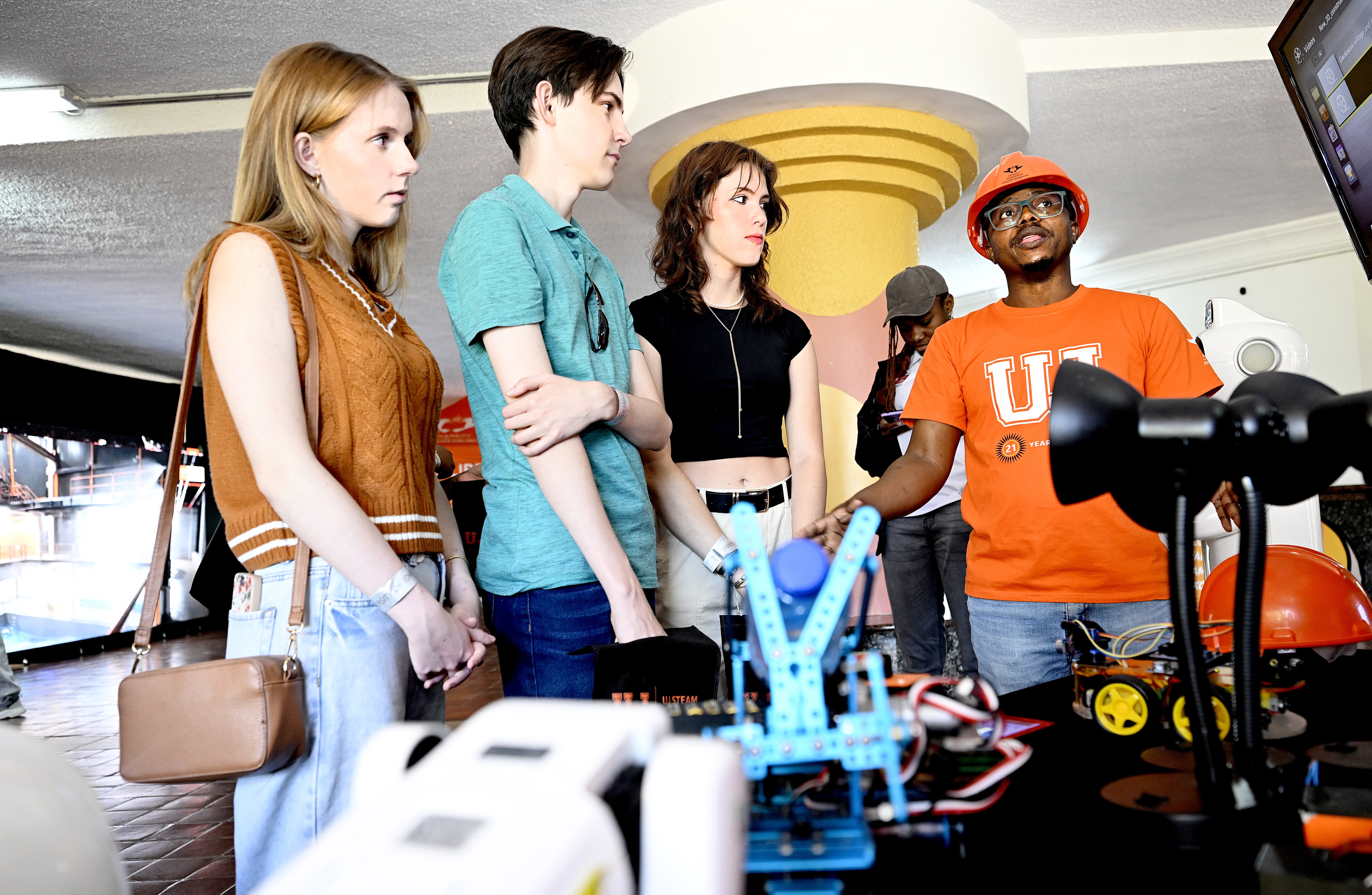
Artificial intelligence, robotics, digital technologies, engineering, design, data and scientific research are creating new opportunities while changing the skills employers will need. At the same time, including the Arts in STEAM underlines the importance of creativity, communication and design in tackling complex problems.
That combination is increasingly relevant as young people prepare for careers that may look very different from those available today.
The emphasis on early exposure also reflects UJ’s wider investment in technology-driven education. Its Centre for Advanced Learning Technologies in Science, Technology, Engineering, Arts and Mathematics has been exploring artificial intelligence, virtual and augmented reality and machine learning, while supporting coding and technology initiatives involving school learners.
Liaq Scholtz, a Grade 8 learner from UJ Academy, said the STEAM Expo was different from other expos.
“What makes it different is that it gives more interactive education and a technological experience while ensuring that we bond and have fun throughout. The STEAM Expo also helps you decide what you want and what you are passionate and interested in compared to other events.”
An interest in mathematics could open a pathway into data science or artificial intelligence. A fascination with technology could lead towards computer science, engineering or robotics. A passion for creativity could connect with design, architecture or digital innovation.
“The expo presents an opportunity to see the university not simply as a place where people obtain qualifications, but a place where ideas are developed, questions are asked, solutions are tested, and futures are created,” said Anathi Sidali, Senior Manager for UJ Broadcasting.

Prof Mpedi concluded: “Our campuses are places where school subjects could be connected to real technologies, research and careers, giving young people an opportunity to imagine themselves not simply as future university students, but as the scientists, engineers, designers, entrepreneurs and innovators who will help shape South Africa’s future.”