Professor June Bam from the University of Johannesburg (UJ) has been awarded the first visiting AfOx (Africa-Oxford) fellowship at Lincoln College at the University of Oxford.
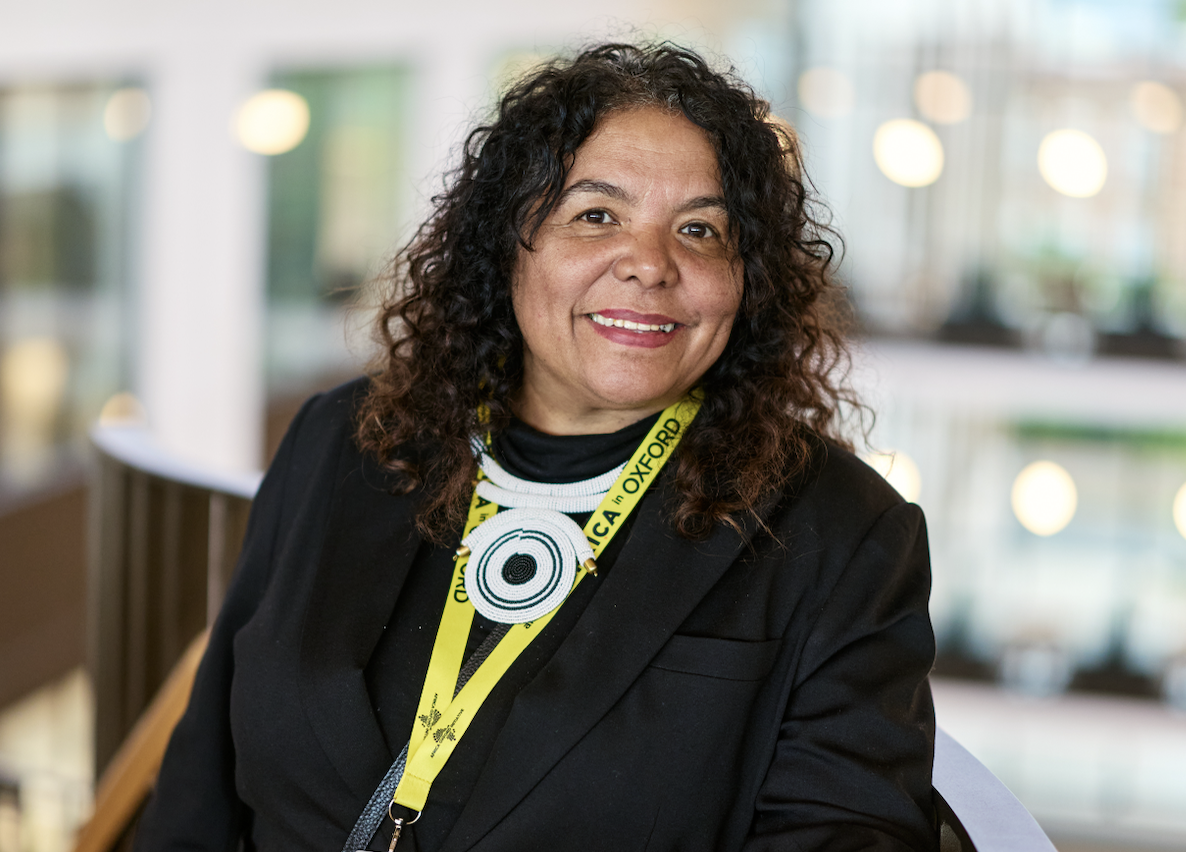
Prof Bam is Director of the Centre for Education Rights and Transformation (CERT) within the UJ Faculty of Education.
“I feel honoured to be Lincoln College’s first selected AfOx fellow, which coincides with their 600-year commemoration. The process of appointment as a visiting fellow at Lincoln College is a particularly competitive one, I believe. Women were only admitted to study at Lincoln in 1979,” says Prof Bam.
Africa-Oxford visiting fellowships
AfOx fellows are affiliated with the University of Oxford for 12 months, including a two-month residency in Oxford itself. The programme enables exceptional African researchers to build international networks and pursue a project of their choice in collaboration with Oxford-based scholars.
“Oxford is intellectually a very intense, demanding, fast-paced but equally nurturing and supportive environment. It is a place where the big ideas and societal impacts are systemically supported to thrive,” she adds.
At Lincoln College in Oxford, Prof Bam worked closely with her promoter and host, the global historian Prof Peter Frankopan, author of The Earth Transformed and The Silk Roads.
“The AfOx fellowship helps me to build on a long-established relationship with Oxford, to the benefit of building sustainable foundations for CERT and the University of Johannesburg within African heritage and education. It enables supporting the scholarship of young bright scholars and to network them globally,” says Prof Bam.
She also serves as mentor to Oxford Masters and doctoral students in the African heritage sector, in which she has worked in South Africa for about 40 years, and well over a decade internationally.
Her research at Oxford asks how global ‘precolonial’ history could be rethought from the perspective of the Khoi-San Ausi’s indigenous deep-time knowledge of plants and landscape, as recorded in collections dispersed across the former British empire.
North-South collaboration

AfOx (Africa-Oxford Initiative) is based at the University of Oxford, with the aim of facilitating equitable and sustainable collaborations between researchers based at Oxford and at African universities. It also aims to increase the number of African students pursuing postgraduate degrees in Oxford.
All of the AfOx programmes are developed to enable researchers to co-design projects and co-develop skills to tackle global challenges across all the Sustainable Development Goals.
Fellows work on projects across the four AfOx research themes of Healthy People, Innovation for Prosperity, Integrated Societies and Green Futures. They develop long-term partnerships with colleagues in Oxford, leading to significant research outcomes, joint publications and substantial funding.
“One such outcome of my fellowship is the vision to establish a joint AfOx global chair to strengthen CERT’s work and its financial sustainability as a research centre,” says Prof Bam.
“AfOx provides research and networking opportunities to work with lead scholars and thought leaders in global historiography, such as my Oxford collaborator Professor Peter Frankopan.”
Born among Ausi
“I was born in Cape Town in an Apartheid hospital for ‘blacks’ in the former Slave Cape Quarter, during a period of great suppression in the 1960s in South Africa,” continues Prof Bam.
The place she grew up in was one of racial integration and regular cultural ceremonies, where the ‘Ausi’ in the family infused the children with medicinal herbal baths.
“The ‘Ausi’ were the big and important respected older female figures who lived around the wetlands and taught the children in the surrounding veld about observing important signals in nature. Life for children amongst the aromatic Cape fynbos was somehow a little magical and reassuring, as we were taught how to survive should a natural disaster strike.
“But this self-sustaining community was, like others, violently disrupted by Apartheid forced removals in the 1970s. The ‘Ausi’ women were forced into labour in the factories and as domestic workers in white homes, and were treated as ‘illiterate’ people ‘without knowledge’.”
Early in her career, Prof Bam qualified as a school teacher. She taught hundreds of high school children on the Cape Flats, taught adult night school in the 1980s, and graduated hundreds of university students. She trained many teachers at UCT and at the University of the Western Cape (UWC).
She served as special advisor in the Education Ministry between 2000 and 2004, and as director of the South African History Project which involved curriculum development in the social sciences. Prof Bam has published widely for teachers, learners, teacher trainers, scholars and also the general public.
Towards climate mitigation
As a result of years of engaged research and work with youth and women, she wrote the monograph Ausi Told Me: Why Cape Herstoriographies Matter (Jacana, 2021). This journey brought her to apply for the AfOx Fellowship.
“My research troubles the ‘extinction’ and ‘disconnected people and culture’ discourse,” she says. “Ausi knowledge contributions have been absent from acknowledgment in the scientific and heritage disciplines.”
“I am working with Oxford colleagues on joint funding proposals for major grants and publications. I have also been invited to join a number of research networks.
“Through sustained strategic research collaborations with global leading universities like Oxford, we can see more of these awards and exchanges within the Faculty of Education and UJ at large,” says Prof Bam.
Her work is supported by Oxford development staff in other departments working towards making the joint vision with UJ’s CERT a reality.
The fellowship also builds on her history of global research with feminist indigenous scholars, including the Worldwide University Network project with several global universities, of which she was principal investigator.
The AfOx fellowship at Lincoln College connects the deep knowledge of nature and environment from the Ausi in her youth, to one of the most pressing challenges the world faces today.
“My fellowship with Oxford builds on layers of foundational work within creating alternative decolonial knowledge. The goal is to help mitigate the current climate change crisis,” says Prof Bam.