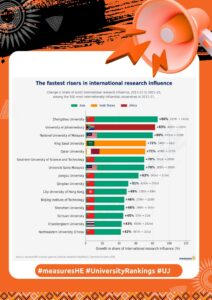
The University of Johannesburg has recorded an 83% increase in its share of international research influence, rising from 468th to 226th place in the latest measureHE analysis.
The University of Johannesburg (UJ) has been recognised among the world’s fastest-rising universities in international research influence, reflecting the growing reach of its research and its contribution to global scholarship.
According to the latest analysis published by measureHE, UJ recorded an 83% increase in its share of international research influence, improving its position from 468th to 226th among the 500 most internationally influential universities identified in the 2017–2021 baseline period. The analysis featured UJ’s improvement as the second-largest increase recorded.
Founded by former Times Higher Education data specialists, measureHE examines the extent to which research from one university informs and is built upon by researchers elsewhere in the world. Its approach places particular emphasis on citations from influential research, providing an indication of the international reach and impact of a university’s scholarship beyond the volume of research it produces.
The result highlights the contribution of UJ’s researchers, academics and postgraduate students, as well as the international partnerships that support knowledge creation and exchange.
Growing global research profile
UJ’s progress in international research influence forms part of a broader trajectory of institutional achievement.
In June 2026, the University reached its highest-ever position in the QS World University Rankings, placing 292nd globally and entering the top 300 for the first time.
UJ was also recognised as South Africa’s leading producer of accredited research outputs for the fourth consecutive year, recording 3,513 accredited research output units, equivalent to 13.52% of the national total. More recently, 88 UJ researchers were included in the latest World’s Top 2% Scientists list, while the University’s cumulative number of National Research Foundation-rated researchers reached 389.
Together, these milestones reflect the depth of UJ’s research enterprise and its growing visibility and influence within international academic communities.
Research with a wider purpose
Commenting on the measureHE analysis, UJ Vice-Chancellor and Principal Professor Letlhokwa Mpedi said the University’s growing international research influence affirmed the work of its researchers, academics and postgraduate students, alongside the global partnerships through which knowledge is advanced.
Through its Strategic Plan 2035, UJ aims to strengthen its position as an international university of choice, anchored in Africa, while expanding research excellence, international collaboration and knowledge that responds to complex challenges facing the continent and the world.
For the University, international research influence carries a responsibility to translate scholarly achievement into meaningful contributions to society. This includes generating knowledge that informs policy, advances innovation, supports sustainable development and improves lives.
As Professor Mpedi has emphasised, UJ does not aspire simply to be the best university in the world, but the best university for the world. The ambition places the value of research not only in international recognition, but also in its potential to address societal needs and contribute to humanity.