Lufuno Ndou wanted to pursue a career that involved medicine when she finished school. When the newly unveiled Science Centre at Hanyani High School officially opened on Monday, 7 September 2026, Lufuno quickly changed her mind and decided to focus on becoming a biotechnologist.
The centre, a partnership between the University of Johannesburg (UJ) and Barloworld, will empower learners with the knowledge, practical skills, and confidence to pursue careers in science, engineering, and technology. The facility is equipped with microscopes, 3D printing technology and digital learning resources, among other amenities.

Lufuno’s excitement was shared by her Grade 11 peers who got the chance to explore the centre, experiment and learn about the new equipment they would be using.
“This lab makes you want to keep learning about science. We can now do practical things and see the results. I want to be more involved in science because there are so many interesting parts to it.”
After putting her mixing skills to the test, in a test tube, Lufuno’s eyes lit up when her solution turned pink.
“I am happy because I get to see this in real life. I used to only see these kinds of things on TV and in textbooks. Now I will be able to get even better grades for my work.”
This was the sentiment shared by her science teacher and HOD, Ms Mbedzi who said the centre represented an investment in their learners’ education, potential, and future.
The centre marks another milestone in the University’s transformative Societal Impact project by addressing critical infrastructure needs for communities.
The groundbreaking project, which began in 2014, spans several villages, including Gwakwani, Matatani, and Mbodi. Residents have significantly benefited from sustainable solutions in energy, water, connectivity, education, food security, and healthcare, all aimed at addressing the UN Sustainable Development Goals (SDGs).
Dr Avathakali Nephalama from the Department of Education in Limpopo described the unveiling as significant for the Vhembe district and for rural learners.
He highlighted the value of practical science learning versus only reading from books and urged responsible care and use of the centre.
“It is not the responsibility of the giver to take care of the gift. It is the responsibility of the receiver,” and warned against misuse or vandalism of equipment.
More than a new educational facility, the Science Centre reflects a commitment to creating lasting societal impact through partnerships that transform communities by expanding access to quality education, innovation and opportunity.
Mr Vusi Dondolo, Limpopo General Manager, Barloworld, spoke on behalf of Divisional Chief Executive Officer Andronicca Masemola.
He said it was through projects like UJ’s Societal Impact that shows how knowledge can be translated into tangible solutions.
“Learners thrive when the conditions around them enable them to succeed. Sustainable change is never the work of one institution. It is built through trust, shared responsibility and consistent action.”
The science centre serves as a practical bridge between classroom theory and real-world industry needs, preparing learners for careers in science, engineering, technology, and related fields.
“This centre belongs to you and your future,” he said to the learners, “Use it fully. Be curious, ask the difficult questions, do not be afraid to experiment, to make mistakes, and to try again. Science advances because people are willing to question what is known and imagine what could be possible.”
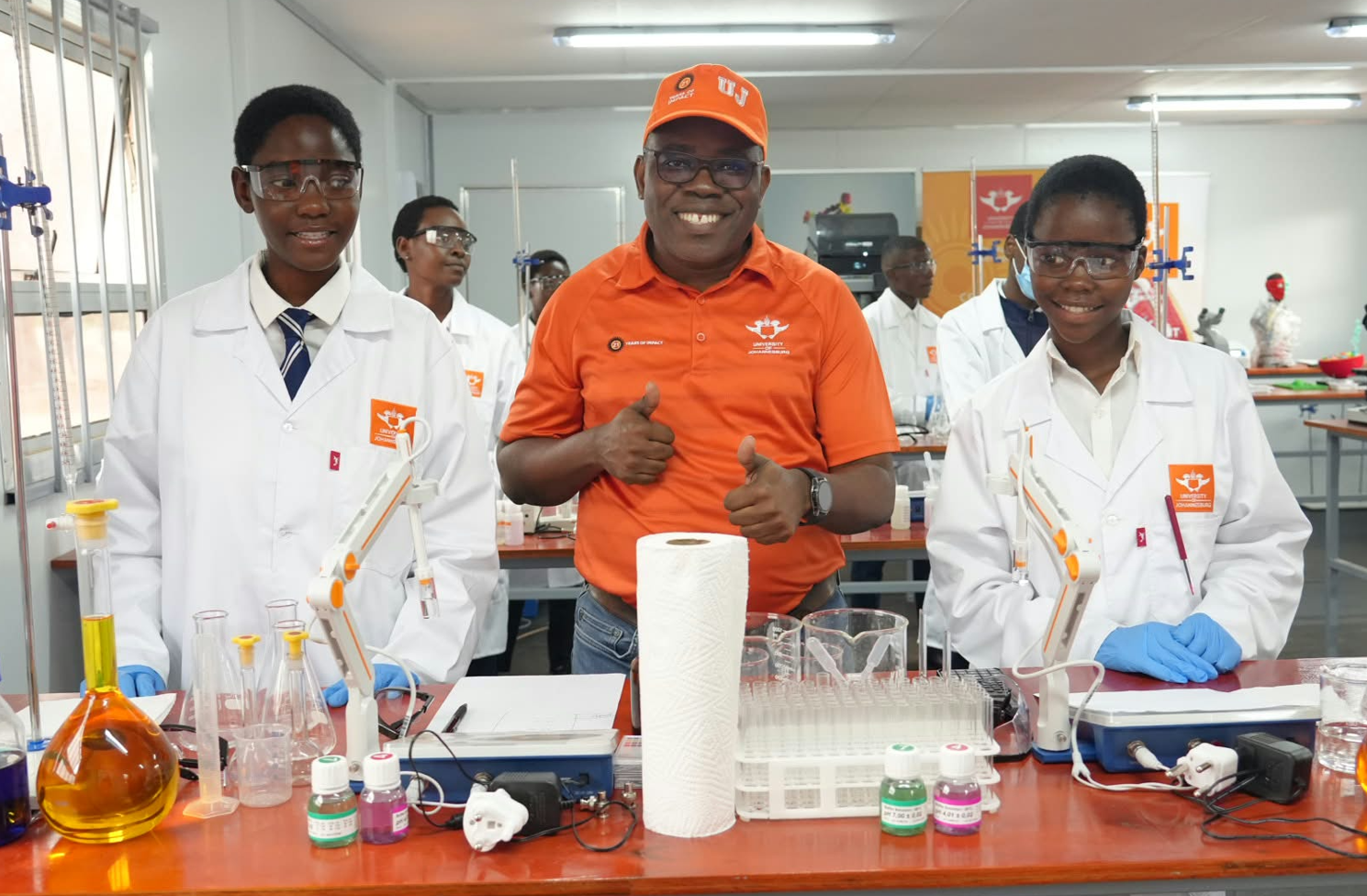
UJ’s Vice-Chancellor and Principal, Professor Letlhokwa Mpedi emphasised that the centre was a partnership-driven initiative to bring world-class science resources to the local community, aligning university, corporate, and school efforts.
“Local talent deserves global opportunity,” he said adding that rapid technological change define this era.
“Technology without human purpose is hollowed. Science achieves its highest schooling when it transforms communities, solves local challenges and unlocks human capability.”
Prof Mpedi’s message to the Hanyani High School learners was one of encouragement: “Science is a mindset, it is the courage to ask why, the curiosity to ask how and the determination to ask what if.”
He also encouraged the teachers to continue being the anchors for this initiative.
“May this science centre be a beacon of excellence for years to come. At UJ we say, ‘we don’t want to be the best university in the world, but we want to be the best university for the world’.”

Professor Annah Moteetee, Dean of the Faculty of Science at UJ, said the science centre was a space of possibility. She reinforced UJ’s commitment to societal impact, emphasising that the true measure of the centre would not be the building itself, but the transformed lives of the students who pass through its doors.
“We are creating a place where young people can encounter science not only through textbooks but through experimentation, discovery and practical learning. The true impact of the sector will ultimately not be measured by the equipment housed within it or by the building itself. It will be measured by the learners whose lives are changed because they were given greater access to opportunities in science, technology, engineering and mathematics.”
UJ’s Societal Impact project partners including MNS Attorneys, Schneider Electric, and Container World were also in attendance.
As the formal speeches concluded and the doors opened, students poured inside to explore the facility. Lufuno remained at her lab station, watching the pink liquid settle in the test tube. For her, the science centre represented opportunity and a place to discover, explore, and dream.