On a Tuesday in September, UJ Engineering lecturer Mr Preveshin Maduray landed back in South Africa from a research trip to China. The very next day he had to teach a class – but found himself teaching rather differently than usual. For at least 45 minutes, he was ‘shouting’ at his students, he recalls.
“I was telling them them they have to do better, better for themselves, for our country, and contribute towards science and engineering. I spoke to them about what was being done at HEPS as well as what the Chinese were able to achieve.
“I believe it all comes down to mindset. We should not allow our circumstances to limit our potential. As engineers we are problem solvers and that’s the initiative we need to start taking,” he says.
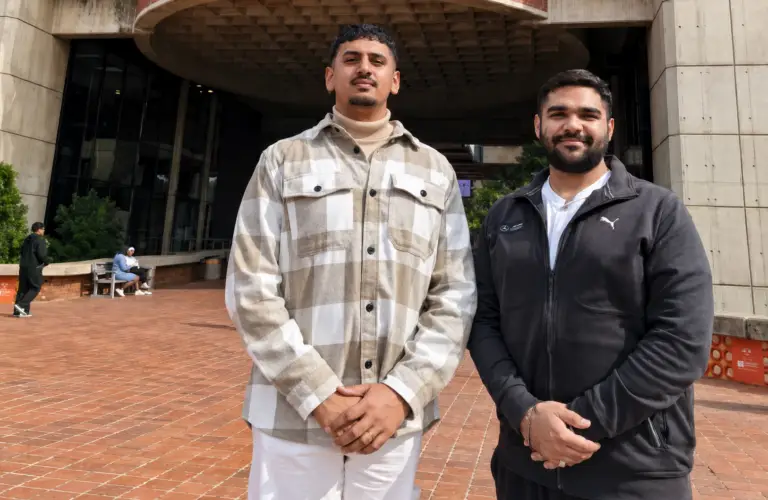
Maduray and Mr Abdool Sattar Cassim, both UJ Engineering PhD students, had spent seven days at a training camp at the HEPS synchrotron in China, from 13 to 19 September.
Seeing inside solid materials
A synchrotron is a high-energy light source, that can ‘see’ things that the eye or a microscope would not pick up. High-energy X-rays from a synchrotron can even ‘see’ inside solid metals, rocks, or fossils, without harming or cutting the sample.
China’s High Energy Photon Source (HEPS) is a fourth-generation synchrotron, offering scientists advanced AI and big-data processing. It is the first high-energy synchrotron radiation light source in China and opened to global users in the second half of 2026.
Maduray and Cassim were among four selected from Africa for the BRICS-STARS programme, supported by the Institute of High Energy Physics at the Chinese Academy of Sciences (CAS). CAS is ranked the foremost research institution in the world, according to the Nature Index institution rankings.
They also visited the Synergetic Extreme Condition User Facility (SECUF) at the Chinese Institute of Physics, as part of BRICS-STARS.
Mind-opening facility
The camp brought the two together with students from other BRICS countries: Brazil, Russia, China, Egypt, Thailand and Ethiopia.
“I was taken aback at how vastly different our projects were, ranging from pharmaceuticals, medicine, to material science and chemistry,” says Cassim.
The other students were more versed in the methods needed for different experiments, while the UJ pair came mainly as users, with an experiment that needed synchrotron-level technology, he adds.
“I felt part of a community that was listening to me, a mere PhD student from South Africa,” he says. “People were extremely friendly and helpful.”
He arrived knowing nothing about synchrotrons and left knowing exactly what he would need to do to use the light source for different experiments, he adds.
Meanwhile, Maduray’s PhD co-supervisor Professor Charis Harley says that on his return he told her the experience had opened his mind.
“As his supervisor this is one of the best responses I could have hoped for!” she says.
So much good food
Away from the beamlines, Cassim, who eats halal, kept asking for vegan food. This made the caterers curious. The next day, they printed labels for each dish, and the ladies still pointed out which ones he could eat and translate for him. “It’s a level of attention and care I haven’t seen anywhere,” he says.
For his part, Maduray found the food ‘absolutely amazing’. “Even though I don’t eat beef and pork, the food service people showed me the chicken or mutton options – mind you all through the translator app” he recalls.
Life at the HEPS synchotron
Safety training was a once-off, made up of two online courses and an online exam. The only safety gear was a dosimeter, worn whenever they were on the beamline, as HEPS is very safely controlled. They were never left without supervision during the beamline tests.
Each day started with lectures on the basics of the science behind the techniques. After a very good lunch, students had practice sessions on the beamline for the experiment they chose. From 2 to 5pm, they could choose from several experiments, such as phase contrast imaging or Raman spectroscopy.
“We both felt very welcomed by the Chinese citizens, they were more than willing to assist even if it meant using the translator app. Good service is path of Chinese culture and we felt it everywhere we went,” says Maduray.
“The beam area is surprisingly quiet,” says Cassim. “The hall of the beamline has a light hum of whatever machinery are switched on, but it is not something your brain will register.”
There is a lot of activity from beamline scientists and other students, 99% of them Chinese, he adds. It is normal to see people on a shift walking around the HEPS ring building at 1am, or ride bicycles because it is so big.
‘Seeing’ with a bright light source
Students who brought their own samples prepared them, set them up on the beam and calibrated it to acquire data, guided by a beamline scientist. The beamline scientist is there to guide users and adapt the beamline to support their experiment. But they are not in charge of making sure the students’ samples are ready, says Cassim.
The UJ pair did not take samples of their own. Instead, they analysed samples chosen for them, with the beamline scientists and other teammates. For phase contrast imaging, they worked on a mouse liver with a tumour, which they could see in high resolution.
“The moment you reach the final images or data, feels like your code compiled after hours of trying to get it to work,” says Cassim.
Coming from an engineering background, Maduray says he felt like a kid in a candy store at HEPS.
“I was just marvelling at the beautiful engineering, the many different beamlines, the quality of the equipment and the neatness within the facility,” he says.
No light source in Africa – yet
In all of the African continent, there is currently no synchrotron at all. It means that any research that needs one, has to be done elsewhere. Not only that: learning how to work at one has to be done elsewhere too.
“As African scientists, we are continuously disadvantaged by not having time to ‘fail and learn’ on a synchrotron so that we master the system,” says Cassim. That was the benefit of the school – we were allowed to have samples that we prep but fail – and then redo. No one chased us to do a perfect experiment.”
Professor Simon Connell says South Africa and many other countries in Africa see a synchrotron as the next most important large-scale research infrastructure for the continent. Prof Connell co-supervises the PhD studies of both Maduray and Cassim.
“Building a synchrotron in Africa is written into the implementation plan of STISA-2034, launched in Addis Ababa in February 2026, with the support of AUDA-NEPAD and the African Academy of Science.
“UJ has been part of advocating for an African Light Source (Synchrotron) for a decade. We hosted AfLS 2024 at UJ and had several students conduct their research at synchrotrons,” he says.
Life changing, so just ask
Maduray says he tells people he came back different, with a different mindset.
“I am highly motivated towards doing more for South Africa and truly inspired by what the people at HEPS were able to achieve,” he adds.
Cassim calls the HEPS facility, beamtime and training the greatest opportunity he has had in his life. He would go back to HEPS without thinking twice, he says.
“As a young researcher, you don’t need to be intimidated by the complexity: people were there at every step to explain each part of the experiment and also to guide you on which experiments are better suited for the study you want to do,” he says.
“So, don’t feel like you need to become a beamline scientist before you do an experiment there: email someone, pitch the idea and let them assist you.”