Two UJ PhD candidates have been selected for a prestigious global training opportunity in China. They will later this year head to one of the most advanced scientific facilities in the world. There they will start learning how to scan samples of human tissue and silica fibres at a scale and clarity not possible otherwise. This technique can speed up scientific research in an unprecedented way.
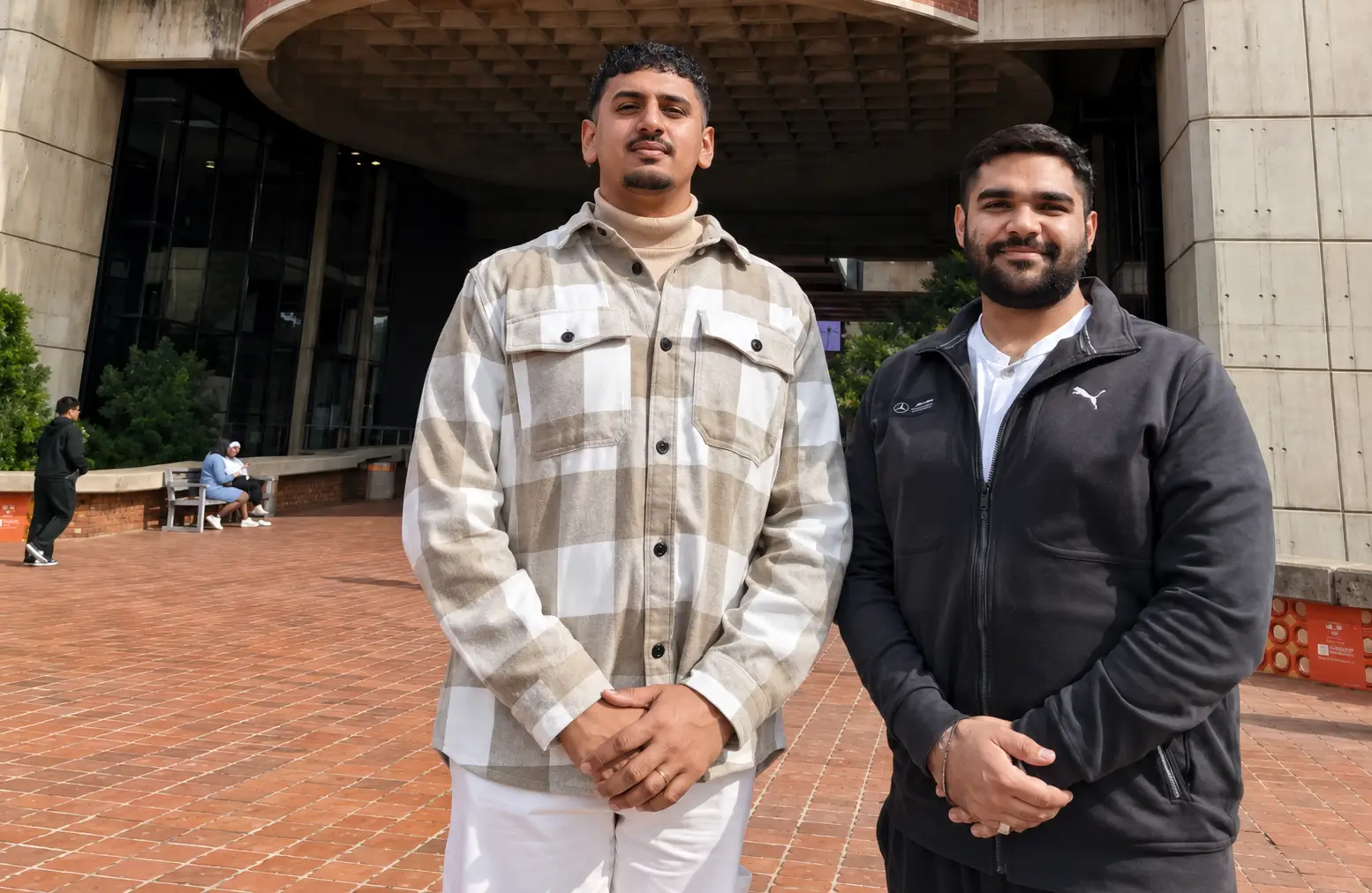
The two candidates, Mr Preveshin Maduray and Mr Abdool Sattar Cassim, will be attending a week-long summer school at China’s High Energy Photon Source (HEPS). They were among four selected from Africa. The BRICS-STARS programme is supported by the Institute of High Energy Physics at the Chinese Academy of Sciences (CAS). CAS is ranked the foremost research institution in the world, according to the Nature Index institution rankings.
HEPS is a fourth-generation synchrotron, offering scientists advanced AI and big-data processing. It is also the first high-energy synchrotron radiation light source in China. It opens to global users in the second half of 2026.
Professor Simon Connell says that beam time at synchrotrons is highly contested and overbooked by a factor of three to five. He co-supervises both the PhD candidates.
“HEPS is a synchrotron for ‘light’ production, from infrared to hard X-rays. It functions as a super-microscope that can ‘see’ in up to five dimensions. It can serve many research disciplines. Examples are the health, energy, minerals, the environment, heritage,” he adds.
Prof Connell is a researcher at the UJ Department of Mechanical Engineering Science. He is one of thousands of global scientists collaborating on the ATLAS experiment at CERN in Switzerland.
Synchrotrons are unlike any other available technology, Prof Connell explains. As an example, researchers overseas used a synchrotron in Europe to ‘scan’ an ordinary-looking rock. The scans showed the fossilised skeletons of two animals hidden deep inside. After processing the scans, the researchers could create an unbelievably detailed 3D image of the skeletons. So detailed, it surpassed photographing them in broad daylight.
“This is the power of a synchrotron. They have not opened the rock. They just zapped it with the beam. And then the computer reconstructed the fossil skeletons,” he says.
The HEPS synchrotron in Beijing, China is housed inside a huge circular building. It requires a walk of 1.36 km to walk around, or the equivalent of four football fields to walk across.

When it opens it will serve up to 15 research groups at a time. Each group is allocated a day to a week on a research question. The research questions are usually a big step towards one of the 17 Sustainable Development Goals, Prof Connell explains.
Mr Maduray is doing a PhD on generating synthetic data to train an AI for disease detection. His research requires extremely detailed scans of human tissue, which only a synchrotron can provide. Maduray is a junior lecturer in the UJ Department of Electrical and Electronic Engineering Science. His thesis is supervised by Prof Connell and Prof Charis Harley.
Maduray’s path to engineering at UJ started in a vastly different subject, he says. His Grade 12 distinction in accounting was higher than his distinction in physics, so he registered for accountancy at UJ. It did not last long.
“I went to my parents and I am like, accounting is boring. The math is too simple. I always wanted to do engineering,” he adds. Even before he had officially switched courses, he started sneaking into engineering classes.
Meanwhile, Mr Cassim is investigating radiation-induced molecular damage to silica fibres used in telecommunications lines. At HEPS he will compare an undamaged control specimen with a damaged one to see how different they are at the nanoscale.
At first, Cassim’s interests journeyed through archaeology, linguistics and astrophysics. Then he decided on engineering. His PhD in Mechanical Engineering Science is supervised by Prof Daniel Madyira, Prof Connell, a technical supervisor from CERN and another two supervisors. Cassim spent nine months at the ATLAS experiment at CERN during his master’s.
He says the HEPS synchrotron boosts the brightness of an ordinary X-ray in a way that can really speed up his research. “It increases this brightness so that you’re able to then see exactly what’s actually going on there, which a normal X-ray machine can’t do,” he adds.
HEPS will be able to emit light that is one trillion times brighter than the Sun at its surface, according to the facility’s website.
Both Maduray and Cassim say they will be focusing on learning how to do things at HEPS, rather than doing their own research during the summer school. The facility is incredibly complex. They hope to scan samples for their PhD research at a synchrotron like HEPS in future.
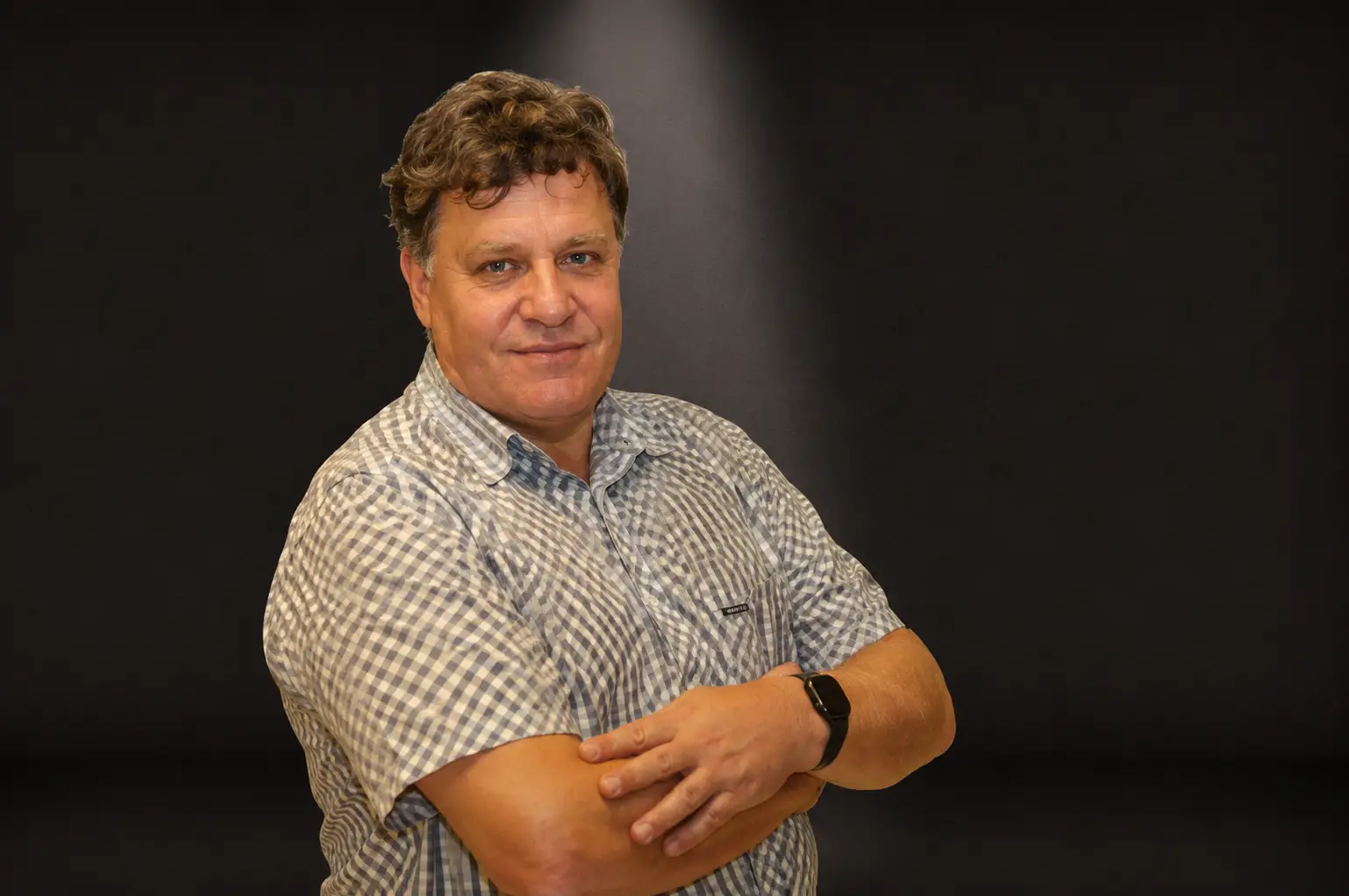
Prof Connell sees the two as high-energy science ambassadors for Africa during the summer school. He expects them to bring back their new synchrotron skills to the continent.
“Preveshin and Abdool will form new networks with peers from around the world. They have the opportunity to gain access to future collaborators and funding and massively boost their own research.”
However they can expect a high energy light source bootcamp, adds Connell.
“Beamline shifts at a synchrotron are 24/7, but of course the researchers rotate and must sleep. The radiation hazards at the actual experimental area and beam production area are shielded off. Multiple redundant fail-safe systems interlock them. Only by following incredibly careful protocols can the beamlines be accessed. They will have to qualify in the relevant safety training before setting foot inside.”
HEPS will launch the BRICS-Synchrotron Technology and Application Research School (BRICS-STARS) in September 2026. BRICS-STARS is dedicated to synchrotron radiation development in BRICS countries. It will provide lectures on X-ray methodology and application with beamline practice.