Early in his research, Professor Faraimunashe (Farai) Chirove started working on ways to predict how infectious diseases will spread inside a human body. One question kept him busy for years.
He was asking himself: “When several strains of a virus, that is, a wild type and one or more mutants compete for the same pool of target cells inside one host, which strain wins, and under what conditions?”
Put more simply: If different versions of a virus fight each other inside the human body, which one will win and how?
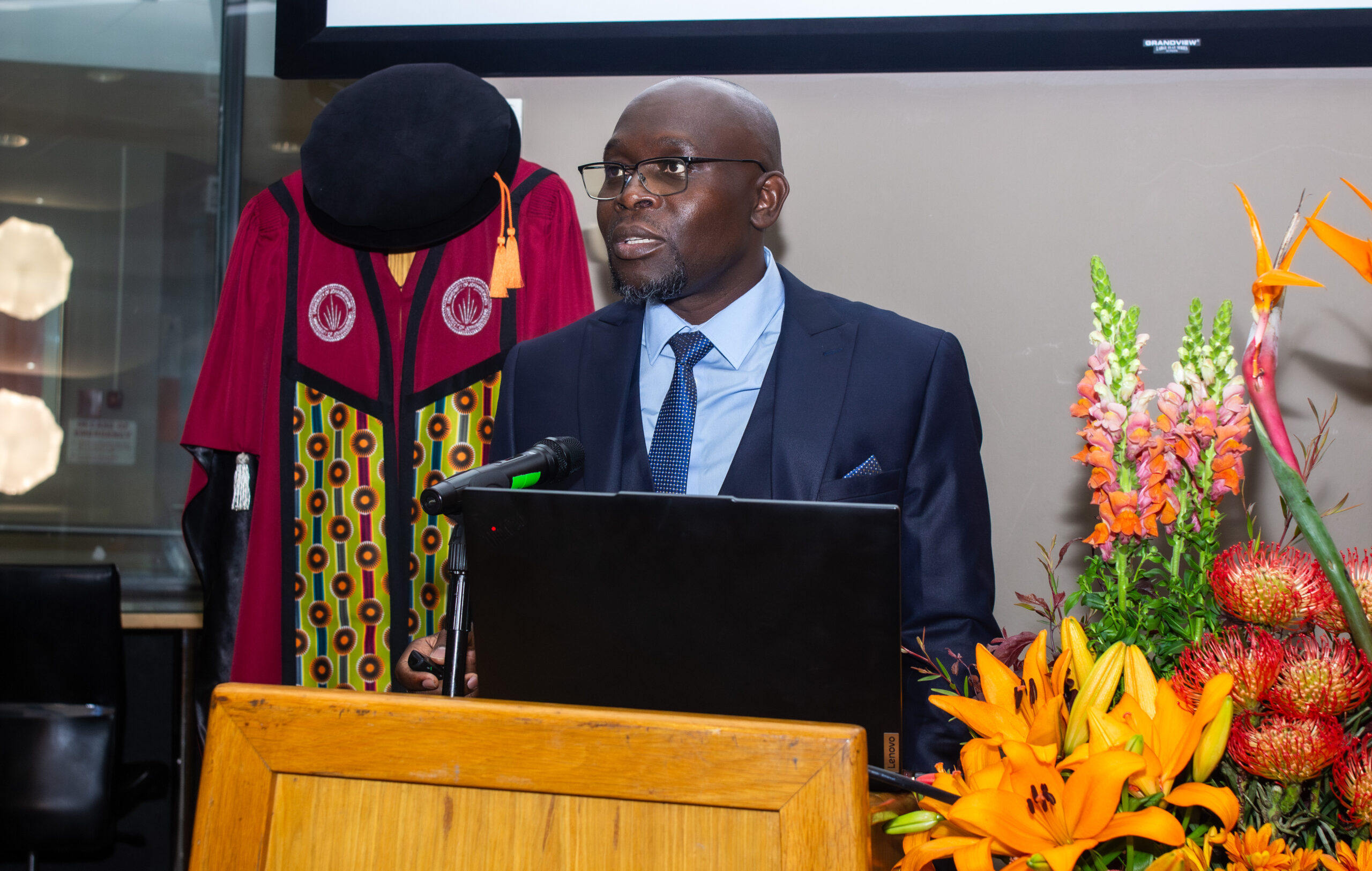
Prof Chirove was speaking at his professorial inauguration on Wednesday 30 September, at the Kingsway Campus of the University of Johannesburg (UJ).
That question is key to understanding whether people with HIV can stay healthy. It applies to other infectious diseases as well.
Prof Chirove is a researcher in the Department of Mathematics and Applied Mathematics, within the UJ Faculty of Science.
Infectious diseases and deaths in South Africa
Over the last two decades, deaths caused by infectious diseases have decreased in South Africa. However, four diseases are still among the top causes of natural deaths in the country.
In 2024, tuberculosis (TB) was fourth, HIV-related diseases fifth, and influenza and pneumonia a combined sixth in causing natural deaths among all age groups in South Africa. This is according to the September 2026 Stats SA mortality report, Table 4.5.
Inside an infected person’s body, different versions (or strains) of the HIV virus compete against one another to infect healthy immune cells. This can be a ‘normal’ HIV virus competing with mutated drug-resistant HIV virus, for example.
Using mathematical models, Prof Chirove discovered that even if every individual viral strain stays below the threshold level needed to take over on its own, having multiple weak strains present at the same time can still add up to a high total amount of virus.
“Thus, a patient can be mathematically stable,” Prof Chirove says, “and still test positive for HIV. Sero-negativity requires the total weak strains viral load to be below that of the wild strain.”
When pills at the same time save a life
For people living with infectious diseases, the likelihood of being cured, or managing it, depends on how successful they are at taking their medications at the same time each day, at the prescribed doses.
In chronic Hepatitis B research, Prof Chirove examined what happens when a patient does not take their medication as prescribed. In these patients, their medication adherence is inconsistent.
Computer models that simulated patient habits, showed that skipping even a single dose of antiviral medication caused the maximum amount of virus in the body (the peak viral concentration) to rise noticeably.
As Professor Chirove explains, failing to take prescribed medication at the right times, often has grave consequences. Over time, the effects of missed doses build up. Drug-resistant strains of the virus get the opportunity to survive the medication and multiply inside the person. These strains can infect other people also. As a consequence, the medication becomes less effective for the patient – and for others with the same strain of the virus.
From one human cell to the human population
One of the big challenges of forecasting how an infectious disease will spread, is the mathematical gaps between what happens inside a sick person; what happens between people, and what happens between communities.
It is one infectious disease, but many scales: the protein scale; the human cell scale; the personal, communal and population scales.
For Prof Chirove, these different scales represent both his complaint against and his love for the science of infectious diseases.
“The virologist studies the virus,” he adds.
Meanwhile the immunologist studies the cell containing the virus. The clinician studies the patient, the epidemiologist studies the population, and the policymaker studies the province or the country.
“Each of them is correct, but a disease is not a pile of disconnected observations made at different scales. The disease is one system, from the molecule to the cell, to the host, to the population, and finally to the society that must decide what to do about it,” he says.

Connecting the virus to the human, the community and population
When Prof Chirove works at the population scale, he is building maths to model how the virus or bacterium (the pathogens) operates inside many people, who are connected by contact, movement, and shared environment.
Here he asks a series of four questions.
“First, I have to understand the transmission mechanism itself. How does the pathogen actually spread? Second, identify the human and environmental drivers that complicate that spread, such as fear, stigma, or environmental reservoirs.
“Third, test candidate interventions: what happens if we act? Fourth, turn the results into policy-actionable decisions: which intervention, at what cost?”
As Prof Chirove builds the maths to connect the scales from the human cell to the human population, he is building multiscale mathematical models.
A sharper measurement of disease spread
More recently, he has been asking himself another, tougher question to improve the understanding of disease systems using multiscale models.
“How do interactions at within-host, host, population and environmental levels combine to shape disease dynamics and intervention success?”
The newer models connect how a virus multiplies inside one person (within-host disease progression) directly to how a disease spreads among thousands of people (population dynamics) by tracking a single shared measurement.
These models track community pathogen load (CPL) instead of older, conventional statistics.
Moving beyond prevalence and incidence
To understand how dangerous an infectious disease is across a city or region, public health officials need an accurate way to measure overall risk.
Scientists relied on two statistics. Prevalence, which is the total number or percentage of people who have the disease at a specific point in time. And incidence, which is the number of new cases appearing over a specific time period.
“Community pathogen load is a better measure of disease burden compared to raw prevalence or incidence, says Prof Chirove.
The reasons he gives for this are sobering. Prevalence only indicates how many people are sick, not how infectious they are, since some patients carry little virus while others carry a lot.
At the same time, incidence is extremely difficult to track accurately in real life because many new infections go untested or unrecorded.
In contrast, community pathogen load is a calculation of the total amount of virus or bacteria carried across all infected individuals combined in a population.
By calculating community pathogen load, researchers get a single, unified measurement that connects the individual patient (their personal viral level) directly to the entire population (the community’s actual infectious risk).
Maths forecasts for better policy about dread diseases
Working with colleagues and postgraduate students, Prof Chirove has investigated and modelled some of the most frightening infectious diseases in the world.
These include the role of fear and environmental transmission in Ebola; stigma in COVID-19 and Ebola survivorship; environmental transmission of bilharzia (schistosomiasis); insecticide resistance in malaria vectors; the cost-effectiveness of counterfeit-drug-constrained malaria control; optimal social-distancing and vaccination strategies for COVID-19; and targeted vaccination for Ebola.
In cattle, he modelled the multi-transmission route of bovine tuberculosis.
Each stage of the process provided useful data to help African health leaders make better public health policies.
For Prof Chirove, scientific research derives its purpose from human impact and capacity building.
“An academic programme is only as valuable as the people it trains and the communities it reaches,” he says. “For me, this is the point of the science.”
“Mathematics can do more than describe an infectious disease system,” Prof Chirove adds. “Done properly, it can help us see the whole of it, from the person scale to the population scale – and act accordingly.”