Hailing from the historical heartland of the Bapedi kingdom in Limpopo, Ga Sekhukhune, is Dr Linford Molaodi who entered the University of Johannesburg (UJ) as an undergraduate BEd student that knew nothing about coding and robotics in education.
Today, Dr Molaodi has graduated with a Doctor of Philosophy (PhD) in Childhood Education with a thesis titled, ‘Enhancing pre-service teachers’ preparation for teaching through participating in a Scratch Coding Club’.
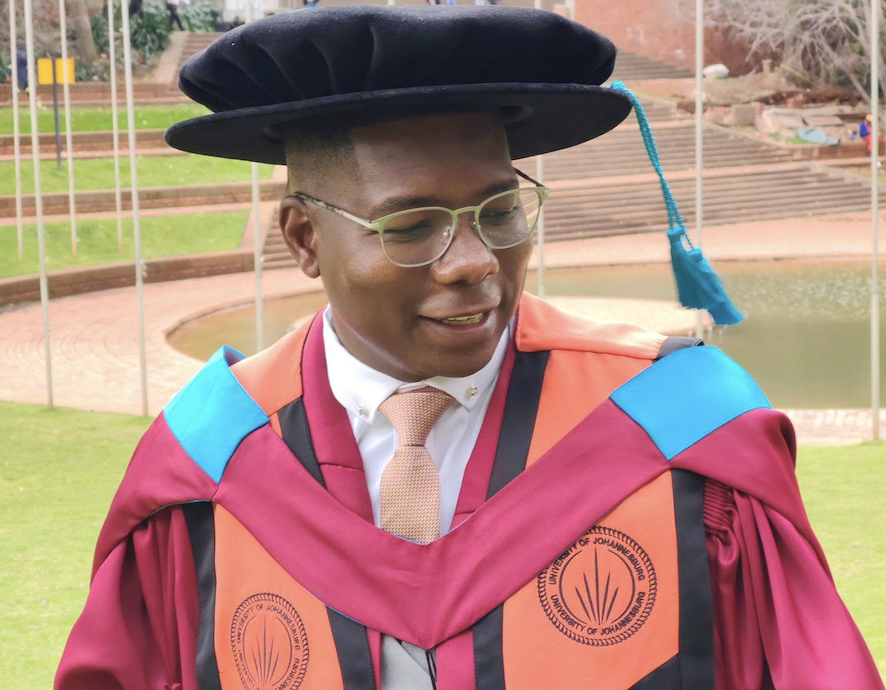
The 34-year-old academic said his journey was inspired by those around him, with key influences including uncle, his neighbour as well as his former high school principal Daniel Manthata who all played crucial roles in him pursuing education as a career.
In his first year of teaching physics and chemistry in Serithing, Ga‑Sekhukhune, Dr Molaodi connected deeply with learners from impoverished backgrounds who struggled with confidence- a struggle he knew first hand. Driven by his passion for teaching and determination to change that, he founded TeaSterl Projects, an NPO offering authentic career guidance and training teachers to use ‘shoe‑string science’ as well as improvisation and technology in the classroom.
“The initiative transformed learner performance and self‑belief, inspiring me to expand it beyond my school community. Today, many of the students I taught in 2015 are thriving as teachers themselves, a testament to its enduring impact,” Dr Molaodi said.
He joined UJ as an undergraduate student and reflected on the journey; “It’s a great honour and joy to be homegrown by UJ, a leading institution in societal impact, innovation, and research. I received care and love during the times I was vulnerable and lacked self-confidence (an experience of almost every young person who moves into the city from a rural village)”, he said.
Early on in his teaching career, Dr Molaodi demonstrated a rare ability to thrive in complex situations by blending technology with ‘shoe‑string science’ in under‑resourced schools.
“This was an approach that was inspired by my mentors Prof J Batchelor, Prof G Lautenbach, Prof J De Beer and Mr M Khwanda. My competence was so evident that my first principal wrote to the University praising UJ graduates,” he shared proudly.
That recognition propelled him through a BEd Honours and Master’s in ICT in Education, culminating in a PhD in Education focused on coding and robotics.
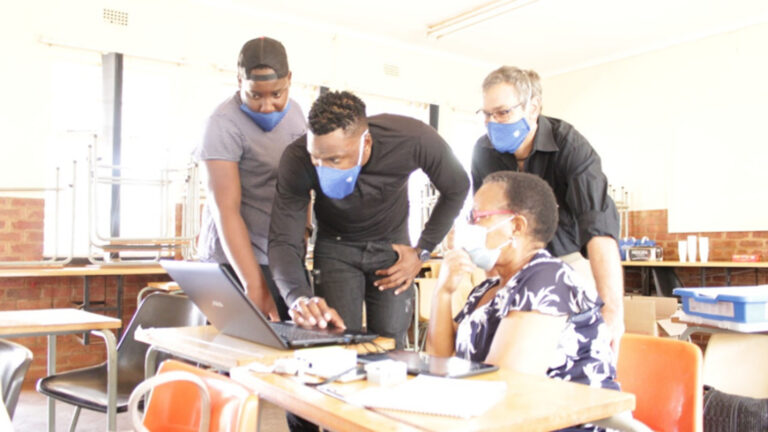
Dr Molaodi’s masters’ research grew from an online enrichment program he created for learners in Serithing, while his PhD was sparked by an informal Scratch Coding Club launched during the COVID‑19 lockdown to support UJ undergraduate students. The club’s success led to a pioneering short‑learning program in coding and robotics, now regarded as unmatched in South Africa and across Africa.
UJ provided the environment for his innovation and as the university’s reputation rises globally, he rises with it. Whether at home or abroad, his affiliation with UJ commands respect and underscores his trajectory, a PhD holder committed to practical, human‑centered solutions that benefit local communities, the continent and the wider world.
Dr Molaodi said one of the most valuable lessons that he has carried as a schoolteacher into his current role training future teachers is cultural and spiritual values of peace, kindness, and respect.
“During my years as a teacher, I built strong, lasting networks with learners and fellow educators. These connections allow me to reach communities with programs that resonate with them because they see my humanity. Academia can be harsh, but I chose to remain rooted in African values and traditions. Every project I run carries an explicit element of humanity, and even my research reflects that. By staying true to who I am and refusing to adopt foreign practices that undermine our humanity, I’ve been able to sustain meaningful academic networks”.
Under the mentorship and supervision of former Dean (of the Faculty of Education at UJ), Prof. Sarah Gravett, Dr Molaodi explained that working with the seasoned academic, introduced him to other spheres of education, which in turn informed how he got into coding and robotics.
“She introduced cognitive and neuroscience and understanding of research in education. She uplifted my understanding of how learning occurs and how to create positive learning environments. The learnings informed my unique approach to teaching and learning of coding and robotics,” he said.
However, one of his biggest challenges when it came to introducing coding and robotics into under-resourced schools was teacher trainings. Dr Molaodi explained that teachers are used to workshops which are characterised by following instructions, procedures and listening to presentations. “It becomes complex to change teachers’ mental structures and adapt to our way of conceptualising coding and robotics,” he said.
As a recipient of the 2019 National Teaching Award for Technology Enhanced Teaching, Dr Molaodi said his vision for innovative teaching matured. “It started involving a focus on learning with and through technology as opposed to learning about technology. At the centre of my innovation teaching vision is learning, not the mastery of the tool used,” he explained.
Dr Molaodi said watching student teachers successfully run a coding clubs fill him with joy. This is a clear sign that teaching and learning are on the right path for societal impact.
One of the initiatives that Dr Molaodi has spearheaded has been the Creative Coding @ UJ short learning programme. He said one of the reasons why the initiative resonates globally is because it centres on personal interests and cultural expression rather than rote technical mastery.
“It is rooted in creative learning, it equips teachers with competencies for a fast‑changing world, critical thinking, collaboration, digital fluency and computational thinking which are areas often overlooked in traditional faculties. Its facilitators are home‑grown, recruited during undergraduate studies and nurtured through postgraduate research,” he said.
Continuous research, strong social media engagement and networks with institutions like the Massachusetts Institute of Technology (MIT) ensure constant improvement and global relevance. Together, these elements make Creative Coding @ UJ a pioneering program that blends innovation, humanity, and cultural resonance, positioning it as a unique force in education worldwide.
Dr Molaodi said his next frontier is focusing on enhancing his academic research footprint and inspiring more universities in Africa to introduce coding and robotics in their faculties of education to support pre-service and in-service teachers.