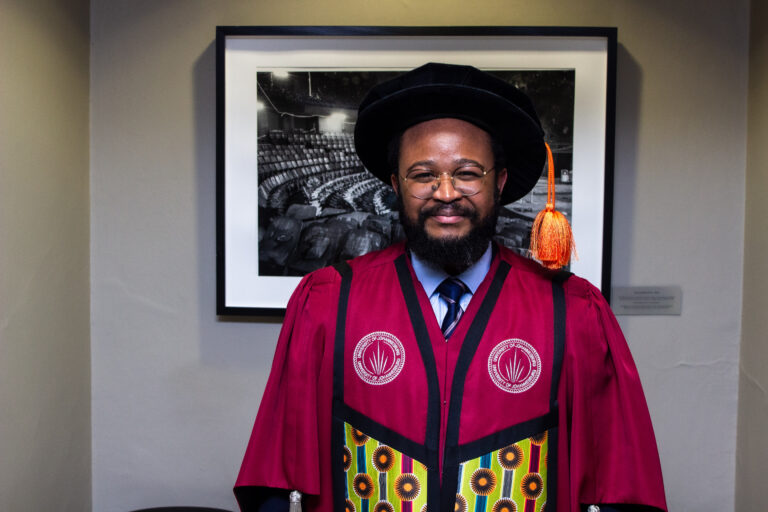
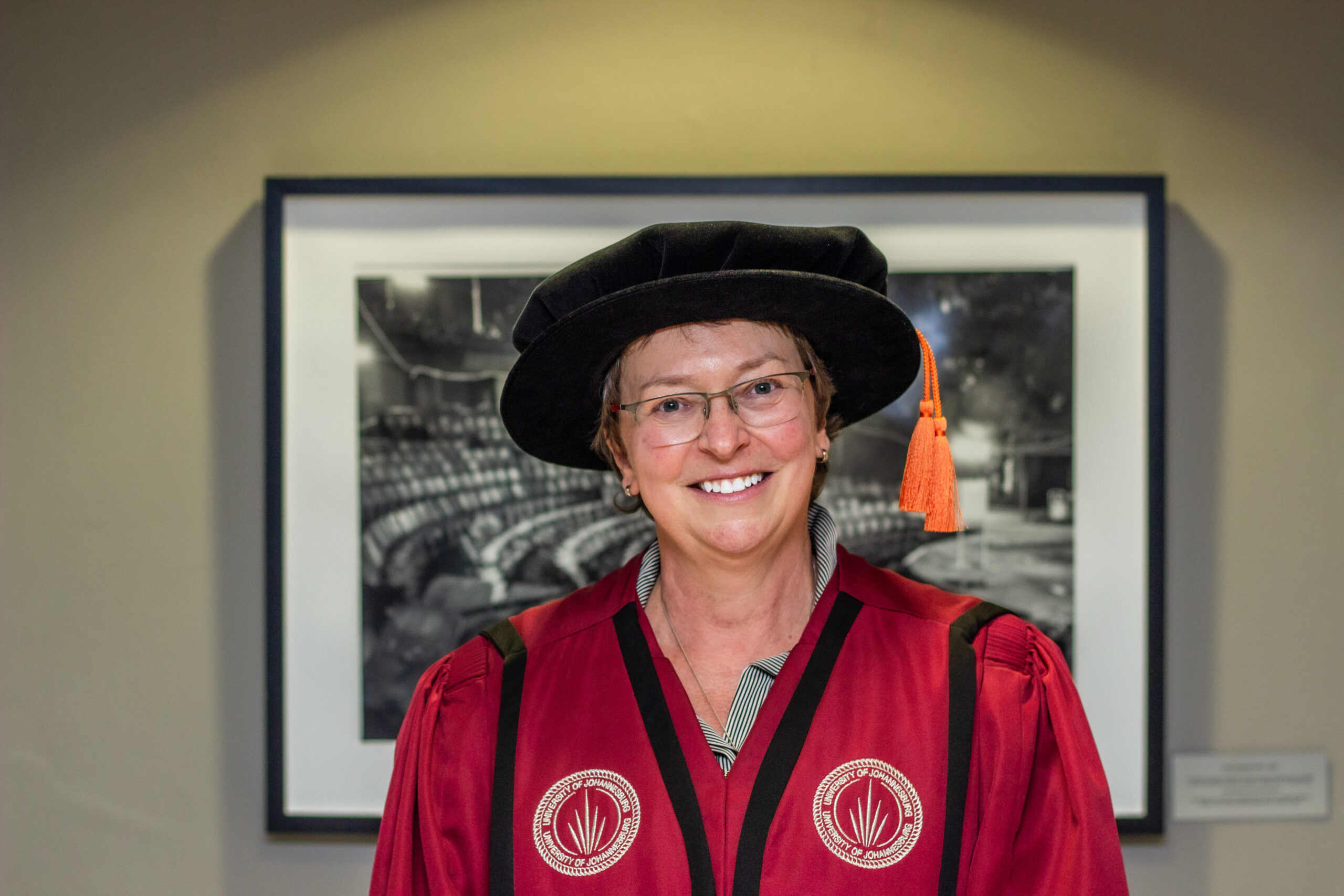
Like many African children of his generation, Professor Mandla Radebe’ earliest experiences of communication were shaped by oral traditions, storytelling, struggle narratives and community life.
His late maternal grandmother, uMaKhumalo, would sing while carrying him on her back as she tilled the land, he says.
“That song was a form of communication. It was a vehicle through which history, memory, identity and resistance were transmitted from one generation to the next. Through song, she communicated the pain of dispossession, the resilience of our people and the hope that future generations would inherit dignity rather than despair,” he says.
Prof Radebe was speaking at his inaugural lecture at the Kingsway Campus of the University of Johannesburg (UJ) on 15 September. He is a professor in the Department of Strategic Communications and the founding director of the Centre for Data and Digital Communication, within the UJ Faculty of Humanities.
“As a child, I did not fully understand the meaning of those words. Today, I recognise them as one of my earliest lessons in strategic communication,” he adds.
National identity contested in digital spaces
That lesson set up the core question in his lecture: How does communication organise power?
“Communication is never a neutral exchange of information,” says Prof Radebe. “It shapes who has the authority to speak, whose voices are listened to, whose experiences are recognised as legitimate, and whose perspectives are marginalised or silenced.”
He became increasingly interested in how communication shapes nation formation, citizenship and democratic legitimacy.
“At its heart, the National Question asks: What is a nation? Who belongs? What binds people together? And how do historically divided societies imagine, communicate and sustain a shared future?
“South Africa’s democratic transition sought to answer these fundamental questions through the establishment of a constitutional democracy founded on equality, human dignity and nonracialism.
“Nonetheless, more than three decades later, political democracy has advanced, but economic inequality remains among the highest in the world. Formal racial segregation has been dismantled, yet the spatial geography of apartheid continues to shape where people live, work and access opportunities.
“Belonging remains deeply contested. The National Question did not disappear with the advent of democracy. It evolved,” he says.
Struggles over national identity, citizenship and belonging now unfold in digital spaces, where competing narratives about migration, race and ethnicity are mediated through social media platforms, hashtags and algorithms.
“The National Question has therefore become the Digital Question,” says Prof Radebe. Questions once negotiated through political organisations, newspapers and broadcasters are now mediated through computational systems whose underlying logic is often commercial rather than democratic.
Who owns the means of Artificial Intelligence
However, the more fundamental question is not what AI can do, but what happens when the production of meaning is no longer exclusively a human activity. For the first time in history, machines are not merely storing or transmitting information; they are summarising, interpreting, classifying and generating knowledge itself, he says.
“Algorithms increasingly shape what societies know, remember and ultimately regard as true.
“The defining strategic assets of the twenty-first century are consequently no longer only factories, mines, newspapers or broadcasting networks; but now include data, algorithms, cloud infrastructure, digital platforms and large language models.
“The contemporary struggle is therefore increasingly organised around what I describe as the means of intelligence: Who owns the data upon which AI is trained? Who determines the values embedded within algorithms? Whose languages, cultures and histories become computationally visible? And who captures the economic value generated through these systems?” he asks.
Deepening future democracy
While generative AI offers considerable opportunities for journalism, editors continue to regard judgement, ethical reasoning, historical understanding and public trust as fundamentally human capacities. Strategic communication must therefore become not merely digitally capable, but algorithmically literate, says Prof Radebe.
Strategic communication theory has largely been shaped by advanced industrial democracies, while societies such as South Africa confront coloniality, racial capitalism, profound inequality and unfinished democratic transformation.
Digital platforms and artificial intelligence promise to amplify citizen voices, yet opportunities to participate remain unequal, shaped by income, education, geography, language and digital access, he says.
“The concept of communicative justice can ask whose voices are heard, whose knowledge counts, who sets the public agenda and who remains excluded,” he says.
African scholarship, he argues, must produce concepts grounded in its own historical experiences rather than supply data for theories generated elsewhere.
South Africa’s experience of colonialism, apartheid, democratic transition and rapid digital transformation provides opportunity for theoretical innovation, says Prof Radebe.
“Artificial intelligence may transform how knowledge is produced and communicated, but it also reminds us of what universities must continue to cultivate: judgement, imagination, ethical reasoning and the capacity to ask better questions.
“Every generation inherits an unfinished conversation, contributes what it can, and passes it forward. The responsibility of our generation is to ensure that this transformation deepens democracy and human dignity rather than diminishes them,” he concludes.