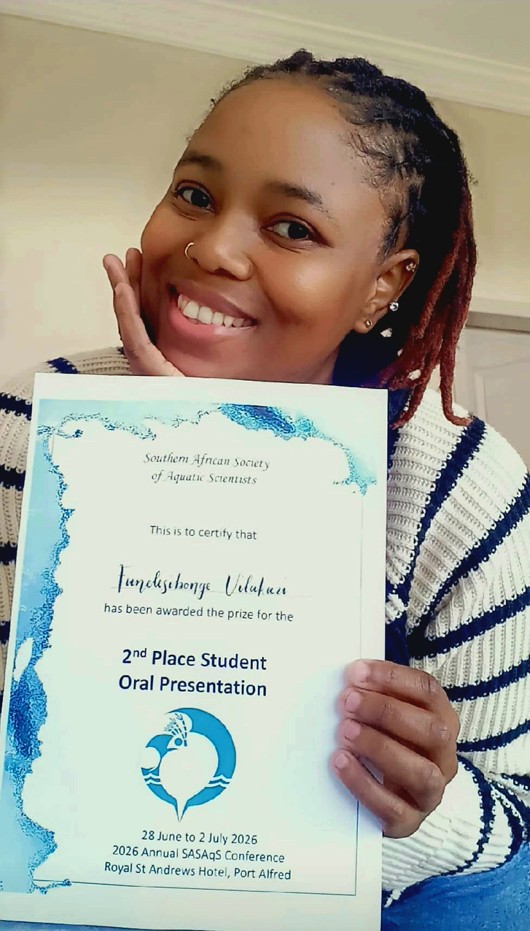
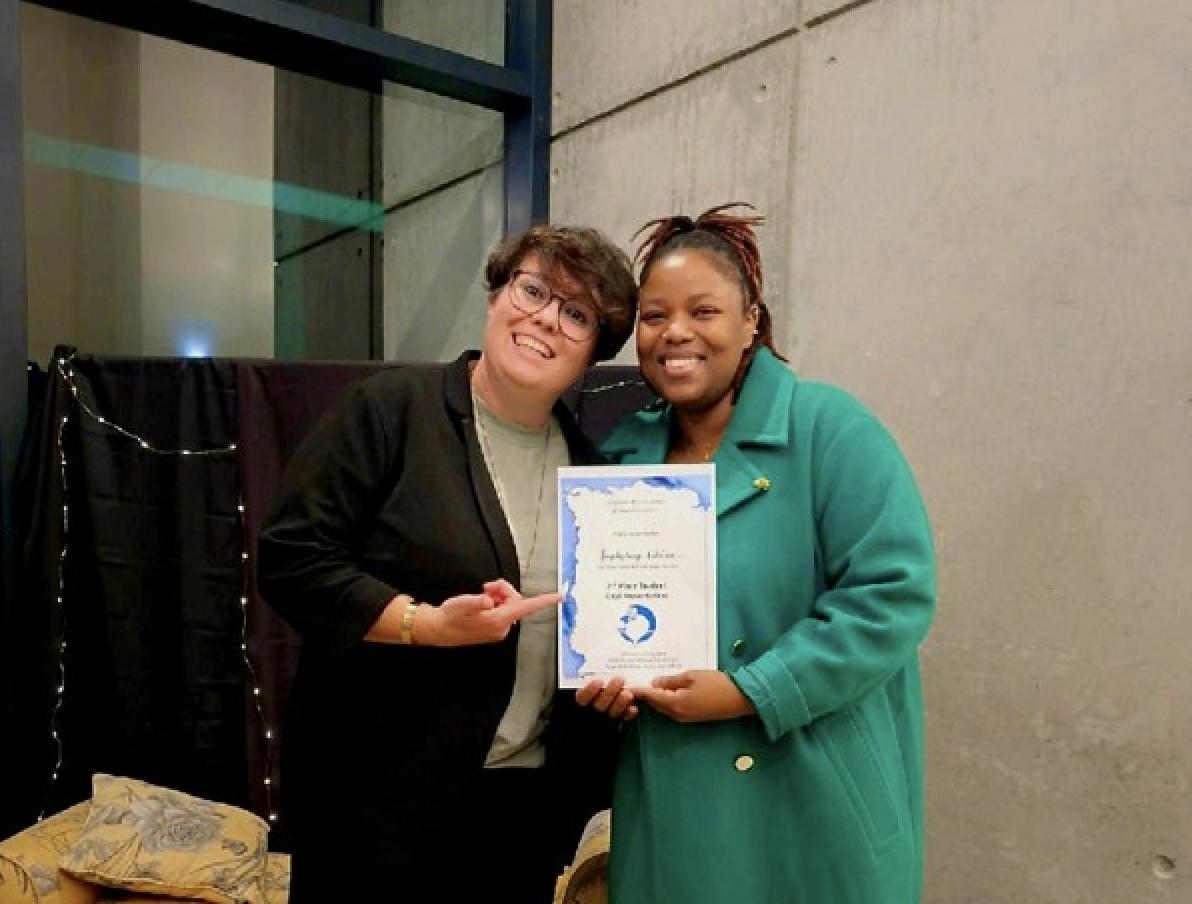
UJ PhD student Fanelesibonge Vilakazi was recently honoured at the South African Society for Aquatic Scientists (SASAqS) for her work, which earned her second place for Best Oral Presentation. She was also honoured with an Excellence in Science Award.
She credits her determination and perseverance for getting her this far and hopes to one day pursue the business side of science.
 What sparked your initial passion for aquatic sciences?
The notion that water is life has always been fascinating to me. Water is used in so many ways, in many different industries and it is one solvent that is of universal importance. Understanding the current global water challenges- the increasing pollution, freshwater shortages, droughts etc. further motivated me to work with water. I truly believe that if my research can help us understand and contribute to protecting water sources and their ecosystems, then it will subsequently protect life as we know it.
Why is this specific area of research so critical for South Africa right now?
Africa as a whole is facing water challenges that are largely due to climate change and pollution. South Africa relies heavily on freshwater for agriculture, industrial and domestic use. However, the little available freshwater is constantly threatened by historic and emerging pollutants that are still not thoroughly explored, monitored, or understood. Additionally, access to clean and safe water is a human right and as such, water should be prioritized and always protected.
Why did you choose to pursue your PhD at the University of Johannesburg?
The University of Johannesburg is amongst the best universities in the country and in the world. Early into my Master’s, I saw an article about UJ being amongst the first institutions embracing 4IR and nanomaterials research. With a background in emerging and historic pollutants, I knew I wanted to continue on that path and explore nanomaterials and their toxicological impacts, but I was struggling to find the institution/project. Not many universities were heading in that direction yet, and the University of Johannesburg really was the perfect match for me. After all, it is the great University of Johannesburg! Who wouldn’t want to be part of the amazing orange army?
Could you explain the core focus of your PhD research in simple terms?
My research investigates how nanoparticles and overall leachate from rapid antigen test kits (home test kits) effect on aquatic organisms, using zebrafish to model lethal and sublethal impacts. This work aims to assess the potential environmental and human health risks posed by the increasing disposal of these test kits.
How has the academic environment, facilities, or your supervisors at UJ helped shape and support your research journey so far?
Since I started at UJ, I have been exposed to different trainings on different lab equipment, workshops, conferences and experts that have broadened my knowledge and diversified my skills. One of the biggest opportunities I have received was when I went for a 3-month international student exchange program in Stavanger (Norway) at the University of Stavanger (UiS) where I received training on cell lines. My supervisors Dr Tarryn Lee Botha and Prof Cobus van Dyk have played a major role in making sure that I am supported and exposed to as many opportunities as possible, even beyond academia.
Congratulations on your achievements at the SASAqS conference! Take us back to that moment: how did it feel to hear your name called for both the Excellence in Science Award and 2nd place for Best Oral Presentation?
Thank you! To be honest, I have never considered myself to be excellent in science at all, but I have always loved what I do and found pleasure in being able to contribute to the field and to society by just doing what I love. Being nominated by the GoGetters’ movement was already unbelievable, and further winning was a huge surprise and great honour. For a second, I thought they had made a mistake when they announced my name! Going on to receive 2nd place for Best Oral Presentation at SASAqS out of so many amazing presentations and research projects felt surreal because each presenter was just phenomenal. Even now, both moments still haven’t fully sunk in yet.
What was your presentation about, and what do you think made it stand out so strongly to the judges?
My presentation was on the Covid-19 nano-enabled rapid antigen test kits, with focus on estimation of waste generation and potential environmental implications when these kits are disposed of in the environment. It formed part of our recent publication, which was the first publication to focus on the potential environmental impact of the Covid-19 rapid antigen test kits. I believe it stood out to the judges because it tackled an issue that we don’t really think about as society. The Covid-19 pandemic introduced a global demand for these kits, but we never really stopped to think about what happened to them post the testing and post the pandemic. The presentation triggered questions that led to much-needed conversations around the regulation, synthesis, use, and disposal of nano waste.
What does winning the Excellence in Science Award mean to you, both personally and for your future career?
Personally, winning the Excellence in Science award gave the joy, confidence and confirmation that the world is noticing and appreciating my contribution to the field. It gave me motivation to keep going, that the long days in the lab are meaningful and do matter even when self-doubt creeps in. Being a young female scientist from rural KwaZulu-Natal, words can never fully express what this recognition means for someone like me who comes from where I come from. This award will always serve as motivation to keep learning and growing as a scientist and to continue to do my work with integrity and dedication.
As a successful woman in STEM, what advice would you give to undergraduate students who might be intimidated by the idea of pursuing a PhD?
The simplest answer is that anyone who is curious, consistent, determined and stubborn can certainly do science and even pursue a PhD in science. I, myself, am no genius; I have failed many times, and I have had moments where I didn’t think I was smart enough for science, but I didn’t give up. Research is not always linear; it is often the furthest thing from linear, which is why you need to be stubborn enough to keep trying and failing that experiment until you get it right.
Looking ahead, what are the next steps for your research, and what is your ultimate career goal once you complete your PhD?
At the moment, the primary goal is to finish my PhD and officially be Dr Vilakazi – the first in my family. Going forward, I would like to expand my research focus into cell lines and cellular toxicology. I would also like to continue mentoring young scientists outside the UJ peer mentor program and, hopefully, one day explore the business side of science.