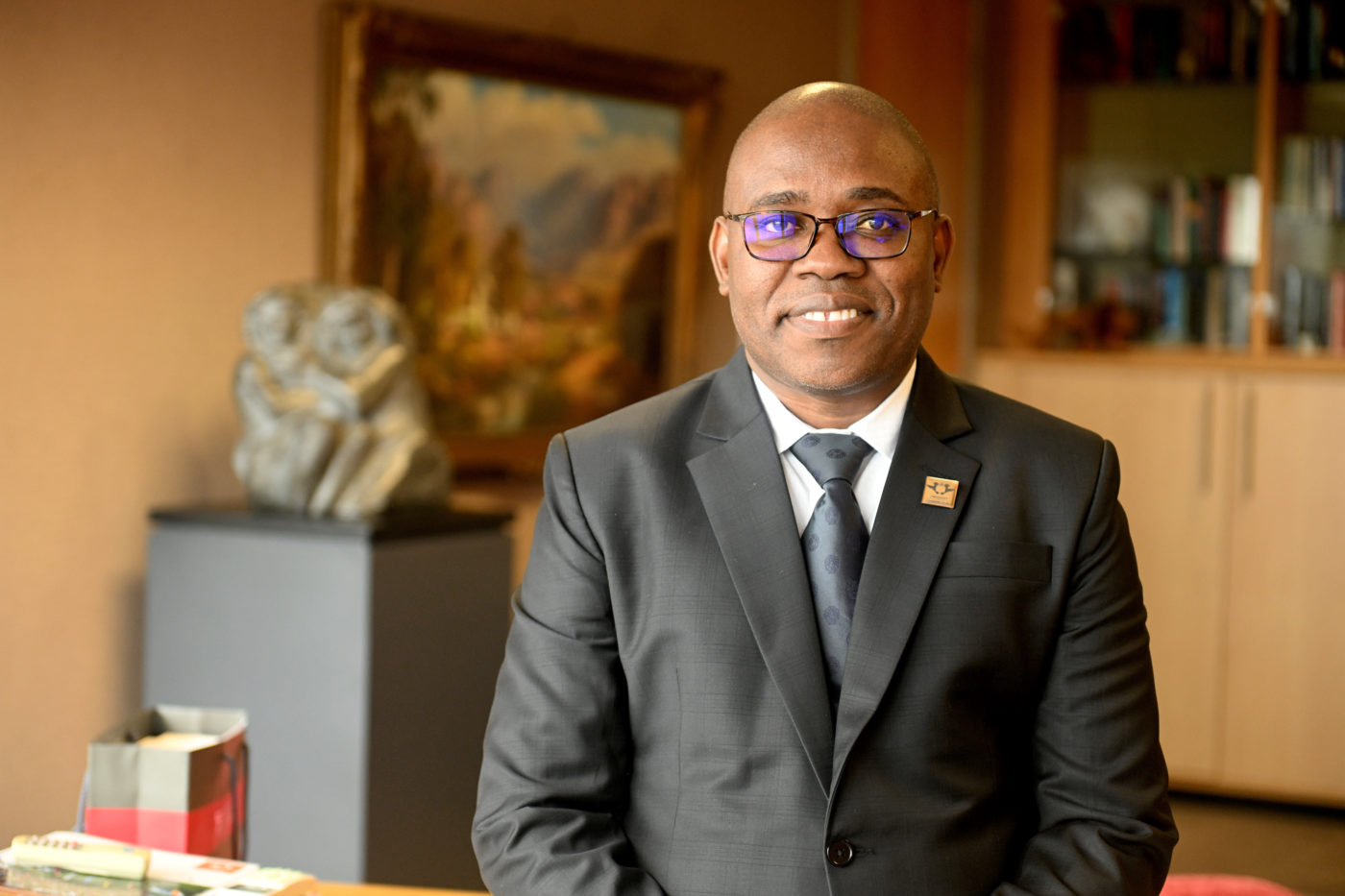
Prof. Letlhokwa George Mpedi is the Vice-Chancellor and Principal of the University of Johannesburg.
He recently published an opinion article that first appeared in the Business Day on 21 September 2026.
Madlanga commission exposes the deep roots of institutional betrayal
When the University of Johannesburg convened its third annual Combatting Corruption Summit this month I did not open with the familiar vocabulary of state capture or institutional decay, but with a philosophical question: what kind of self makes corruption thinkable in the first place? It is a question this country cannot afford to keep deferring, because right now in a hearing room in Pretoria it is being answered for us in excruciating forensic detail, testimony by testimony, name by name.
The Madlanga commission was born out of a single press briefing. In July last year KwaZulu-Natal police commissioner Lt-Gen Nhlanhla Mkhwanazi stood before the media and accused senior politicians and figures within the justice system of shielding organised crime and sabotaging the very investigations meant to stop it. What followed was the suspension of a police minister, the establishment of a judicial commission chaired by retired Constitutional Court judge Mbuyiseli Madlanga, and more than a year of testimony implicating a web of players operating in the shadows between the state and organised crime: police generals, prosecutors, intelligence officials and the businessmen who moved among them. Since then one whistleblower connected to the inquiry has been murdered, and the commission’s deadline has been pushed back three times, most recently to January, because the volume of implications keeps outrunning the calendar.
It would be easy to read all of this as confirmation that corruption is a technical and institutional failure created by weak oversight of police contracts, poor vetting of senior appointments and intelligence structures insufficiently insulated from political interference. But if our diagnosis stops there our remedies will always be one step behind the next scheme, because underneath every technical failure sits a prior, relational one: people, acting on a particular understanding of who they are and to whom they are answerable, corrupt systems.
Ubuntu holds that our existence and our identity are inseparable from the collective. As the Kenyan philosopher John Mbiti put it, one exists because others do, and only because of that mutual existence can the self exist at all. Ubuntu reframes corruption as the substitution of “I am, because I take” for “I am, because we are”. It is what happens when leadership stops belonging, as our constitution’s preamble insists it must, to “the people”, and starts belonging instead to the few who have captured its instruments.
The testimony emerging from the Madlanga commission reads, in this light, like a case study in that substitution at scale. When a whistleblower alleges that a police minister ordered the disbandment of a unit investigating political killings, or when a crime intelligence boss describes a syndicate with tendrils in tender fraud and contract killings, what is being described is a set of relationships in which public trust was treated as a resource to be extracted rather than a covenant to be honoured.
Justice Mogobe Ramose’s account of ubuntu as ubu and ntu (being and becoming) describes exactly what these arrangements arrest. Becoming, in Ramose’s sense, is a shared unfolding in which each person’s flourishing is bound to the next. Every implicated official who allegedly protected a syndicate in exchange for money or advancement collapsed that shared becoming into a static, extractive “I”. The Ghanaian philosopher Kwame Gyekye makes a related point when he insists that African communitarian ethics need not be understood as erasing the individual. He locates individual dignity in one’s contribution to, and responsibility toward, the community. Corruption, then, is a category error about what makes a person’s life meaningful in the first place.
Archbishop Desmond Tutu described a person with ubuntu as one secure enough in belonging to a greater whole to be unthreatened by the good conduct of others, and unafraid to name wrongdoing
The commission’s expanding witness list and its twice-postponed deadline are best read in that register. It is tempting to treat each new name that surtaces as a discrete scandal, unconnected to the one before it. But that misses the pattern. What a year of testimony has shown is how one compromise made the next one easier to justity, until an entire cluster of institutions built to protect the public had been gradually repurposed to protect a network instead.
None of this is unique to policing. Philosopher Thaddeus Metz frames the test of ethical action as one of identity and solidarity”, the degree to which our actions build a shared way of living rather than corrode it. By that test, every act of corruption fails twice over. It subordinates the collective’s interests to the actor’s private interests even as it continues to draw its legitimacy from that very collective. Nigerian philosopher Michael Onyebuchi Eze captures something similar in describing ubuntu personhood as constituted through the recognition of others: “a person is a person through other persons” is a claim about where authority actually comes from.
What ubuntu also explains is why silence so often shields these arrangements for as long as they last. Archbishop Desmond Tutu described a person with ubuntu as one secure enough in belonging to a greater whole to be unthreatened by the good conduct of others, and unafraid to name wrongdoing. The culture of institutional silence the commission has spent a year prising open is rarely born of indifference. More often it is the fear of professional isolation or being cast as disloyal to the very institution one is trying to protect. That fear only loses its grip when accountability is understood not as an attack on belonging, but as belonging’s most basic form of self-defence.
This is why the commission’s work, however uncomfortable, ought to be read as a hopeful undertaking. The Institute of Risk Management South Africa has pointed to a deficit of institutional and leadership capacity as the thread running through the country’s political, economic and social vulnerabilities. That is sobering, but capacity, unlike character already lost, can be built. Leadership, ubuntu teaches us, is for all of us. It looks as much like the junior official who declines the bribe as it does like the commissioner on the stand. Neither act will make headlines, but it is out of thousands of such unremarkable refusals that a resilient institutional culture is actually rebuilt.
No single commission, university or ministry can dismantle systemic corruption alone, and the Madlanga inquiry’s expanding cast of implicated officials is a reminder of just how deep the rot has been allowed to spread. But the commission is itself an act of ubuntu leadership. Its willingness to keep extending its own deadline rather than rush to a clean, premature conclusion is a form of the discipline it is investigating the absence of. It reminds us that accountability is a communal discipline, owed to one another because, as our constitution reminds us, this country belongs to all who live in it.
When its final report lands in January the test will not only be what it recommends, but whether the institutions receiving those recommendations remember that they, too, are because we are.
*The views expressed in this article are that of the author/s and do not necessarily reflect that of the University of Johannesburg.