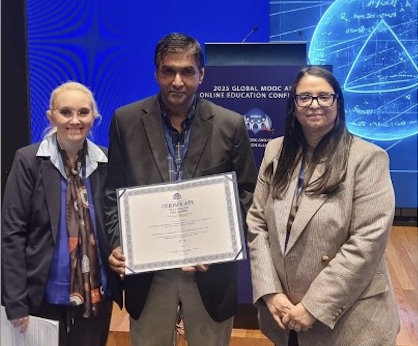
Ylva Rodny-Gumede is the head of the division for internationalisation and professor of communication studies at the University of Johannesburg, South Africa.
She recently published an opinion article that first appeared in the University World News African Edition on 29 February 2024.
As the 2024 registration cycle at the start of the academic year comes to an end in South Africa, it is apparent to administrators and academics that many students are struggling to register due to financial constraints.
For local students, the government-funded National Student Financial Aid Scheme has not paid out bursaries yet and these self-funded students are often crippled by historical debt.
The economic downturn, severe budget cuts and administrative hurdles are affecting everyone – not only local, but international students, too.
The registration of new and continuing international students feels the impact as bursaries are increasingly hard to come by and historical student debt mounts. In addition, and amid mounting pressures to fill the limited number of study spaces, preference might be given increasingly to local students.
Gateway to a better life
In a context in which the economy is in decline and unemployment is rife, access to higher education becomes ever more desirable, despite the cost of a degree.
Investing money in higher education is still seen as a good investment, which is worth sacrifices, as a degree is still, despite high graduate unemployment levels, a gateway to a better life.
For some of our students from neighbouring countries such as Lesotho and Zimbabwe, for example, state bursary schemes have provided access to higher education in South Africa.
However, such funding schemes are being cut and-or conditions changed as to eligibility. Yet, the hosting of international students on our campuses and, in particular, students from the rest of Africa, is crucial for the development of the continent.
But funding is urgently needed not to jeopardise internationalisation, equity and diversity in higher education alongside the other challenges for the registration of international students, such as the speedier processing of visas. This applies to intra-Africa mobility for full-degree and short-term mobility students alike.
If funding is not forthcoming and African governments, as well as the private sector, do not recognise the need to broaden support for higher education and intra-Africa student mobility, not only will the state of affairs affect national economic growth but also the African Union (AU) Agenda 2063 and the African Union New Partnership for Africa’s Development, or NEPAD, that clearly outlines the role and centrality of higher education in the development of the continent.
In fact, 2024 has also been dubbed as the ‘Year of Education’ by the AU in support of Sustainable Development Goal 4, that talks to the importance of quality education.
Ensuring diversity in all of our endeavours as the higher education sector and integrating African and international students, staff and perspectives into teaching as well as research will feed excellence and innovation and counter parochialism and xenophobia.
Africa has a young and growing population, and we need to ensure we can cater for their changing educational needs.
More study spaces, alongside the development of 21st-century skills, and the promotion and creation of opportunities for collaboration and staff and student exchanges are central to such endeavours.
The AU is pushing for more postgraduate students and wants African universities to produce more PhD graduates. To do so, support must be given to universities to share and exchange resources, including staff and students.
Private-sector involvement
While African governments need to commit to bursary funds, the private sector must also make bigger commitments to higher education.
In many cases, it is the private sector that is the direct beneficiary of skilled graduates and, conversely, the biggest loser when the demand outweighs the supply of a skilled workforce.
Private-public partnerships are also needed to fund higher education and closer collaborations need to be forged to look at graduate attributes and skill sets needed to meet the demands of changing economies.
To honour the AU agenda for higher education as well as to build the national economies on the continent, committing funds for international and intra-Africa student mobility should form part of bilateral agreements between African states.
Of course, such commitments must also be followed by equal commitments to ease immigration and visa restrictions and backlogs.
Importantly, it is not only African governments and African companies that have a stake in the funding of higher education, but also foreign governments and international companies operating on the continent.
The support of future generations of graduates should be at the centre of a decolonial agenda.
For a comparative and global perspective, education on the continent is, for the better part, highly competitive and affordable and, if well supported, will continue to deliver high-quality research outputs and skilled graduates.
The rewards are great and the return-on-investment tangible and may be best measured when there is direct investment.
Moreover, we have dedicated leadership across the African higher education sector that is ready to assist and provide the assistance needed to make sure partnerships, as well as graduates, succeed.
*The views expressed in this article are that of the author/s and do not necessarily reflect that of the University of Johannesburg.