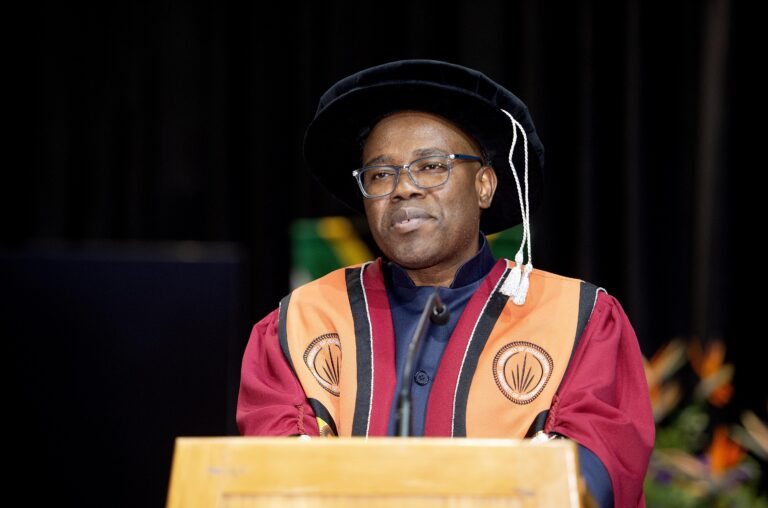
Africa has a narrow but significant opportunity to shape the rules governing artificial intelligence (AI) rather than simply adopting frameworks developed elsewhere, University of Johannesburg (UJ) Vice-Chancellor and Principal Professor Letlhokwa Mpedi said at the CNBC Africa AI Summit 2026 on Thursday, 27 August.
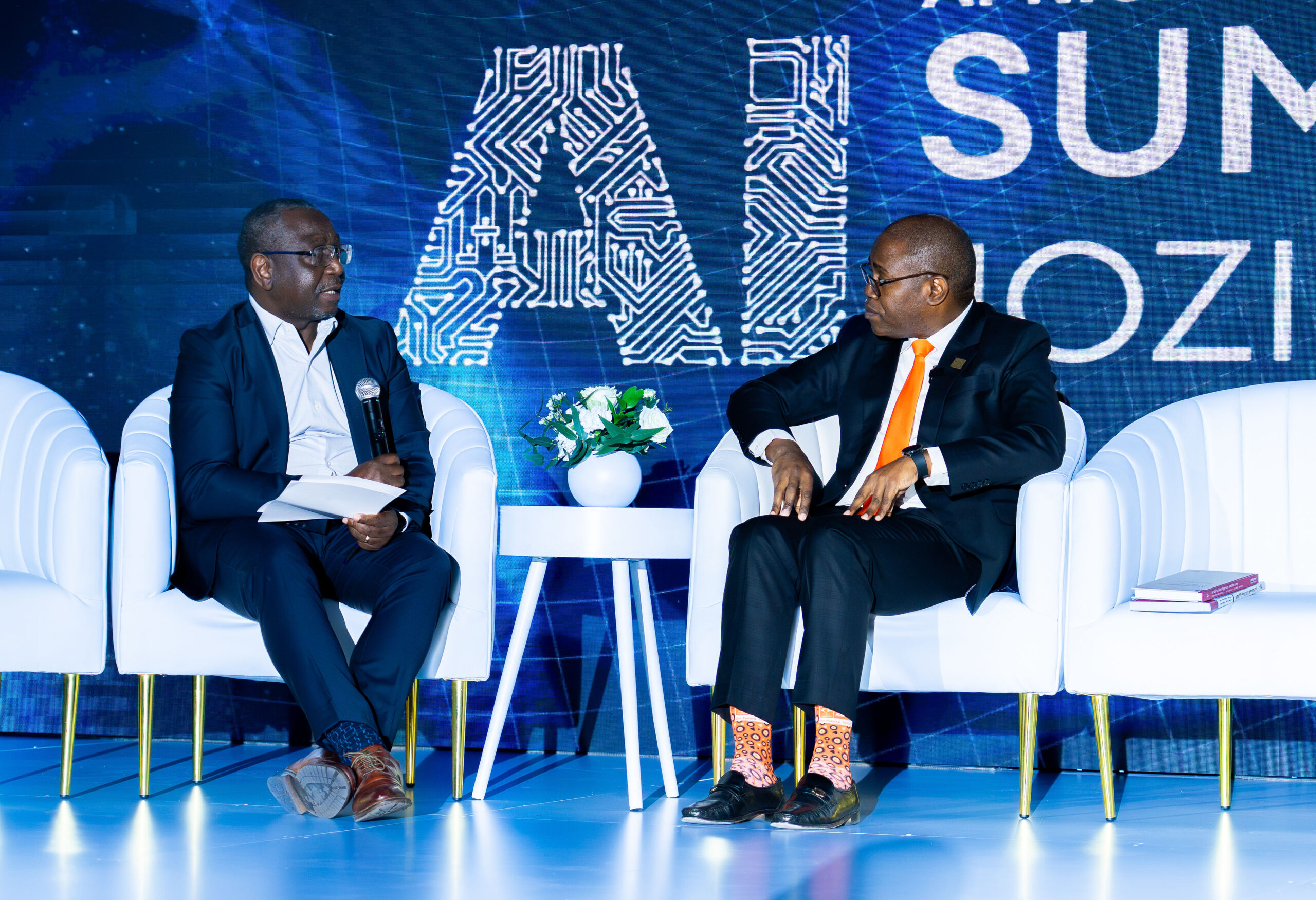
Speaking before an audience of business leaders, technology innovators, policymakers, academics and other stakeholders engaged in Africa’s digital future, Prof Mpedi used the high-level platform to argue that the continent must move beyond being a consumer of artificial intelligence and become an active shaper of the technologies, policies and rules that will define its future.
Prof Mpedi participated in a fireside chat titled “Beyond Regulation: Governing the Future of AI in Africa”, moderated by CNBC Africa Editor-in-Chief Godfrey Mutizwa.
The discussion framed Africa’s AI future within a broader question: how can the continent harness the opportunities presented by artificial intelligence while ensuring that innovation protects human dignity, advances inclusion, and enables Africans to shape the technologies that will increasingly influence their lives? This makes governance a critical part of Africa’s AI future. The continent should not simply replicate regulatory models developed elsewhere but has an opportunity to develop frameworks that are both protective and enabling, creating trust and accountability while allowing innovation to flourish.
“Africa has a genuine window to write rules that are protective and generative,” Prof Mpedi said.
He emphasised that effective AI governance requires clear responsibility across the AI value chain, from developers and deployers to institutions using these technologies. This becomes particularly important as AI increasingly influences high-stakes decisions in areas such as finance, healthcare, policing and justice.
Prof Mpedi cautioned against treating technological accuracy as a substitute for truth or human judgement. AI systems can be probabilistic and can reproduce bias contained in the data on which they are trained. In high-stakes environments, accountability cannot simply be delegated to an algorithm.
These questions are central to the work of UJ’s Institute for AI and the Law, which brings together technological innovation, legal thinking, ethical considerations and questions of justice.
The governance debate also raises a broader question of digital sovereignty. Prof Mpedi argued that sovereignty in the AI age extends beyond infrastructure to include data, intellectual property, knowledge, culture and the ability to negotiate collectively.
With 54 countries and approximately 1.4 billion people, Africa has a collective scale that gives it significantly greater bargaining power than individual countries acting alone. The African Continental Free Trade Area (AfCFTA), he suggested, could provide an important platform for developing common African positions on AI-related issues, including the use of African data to train AI systems.

A coordinated African position on training data could become a significant act of digital sovereignty.
The question is also about who owns the knowledge used to develop AI, whose perspectives are represented, and who benefits from the value created.
This is particularly important given Africa’s linguistic and cultural diversity.
Africa is home to more than 2 000 languages, yet AI systems predominantly operate in languages such as English, French and Portuguese. Prof Mpedi reasoned that this is more than a technical gap because language carries culture, knowledge and different ways of understanding the world.
If AI systems cannot adequately engage with African languages and contexts, they risk failing to properly serve African societies and economies.
Africans must therefore code, write and publish in their own languages so that African knowledge, cultures and perspectives are embedded directly in the data used to develop future AI systems. Without this, the continent risks remaining a source of data and knowledge for technologies developed elsewhere, rather than becoming an active owner and creator of the systems shaping its future.
This also brings intellectual property into sharp focus. Prof Mpedi pointed to South Africa’s protection of rooibos through geographical indication as a useful precedent for considering how African knowledge and cultural outputs can be protected from being appropriated, reproduced and monetised elsewhere without attribution or benefit to the communities from which they originate.
The same thinking, he explored, could inform the protection of African cultural heritage, indigenous knowledge and other forms of intellectual and cultural output in the age of generative AI.
Building this kind of AI sovereignty, however, requires investment in people, research capacity and institutions.
Prof Mpedi identified research and development funding as a critical gap, with South Africa investing about 0.6% of GDP in R&D, compared with more than 2% in many developed economies. Universities therefore have a vital role as research and innovation partners to industry and government.
The private sector cannot solve every research challenge on its own. Universities can connect Masters and PhD students to real industry problems while developing the next generation of African research leaders. Prof Mpedi also called for stronger collaboration among African universities, with greater intra-African partnerships and fewer bureaucratic barriers needed to build a stronger continental research ecosystem.
Universities must also rethink how they prepare young people for an AI-driven economy.
Graduates will need more than the ability to use AI. They will need the technical skills to develop and deploy it, alongside critical thinking, ethical reasoning, legal literacy and civic responsibility. This is particularly urgent in South Africa, where youth unemployment is above 45%.

UJ’s AI work reflects this broader focus on societal impact. AI and machine learning are being applied to challenges including healthcare, agriculture, conservation, climate resilience and access to justice, reflecting a “lab to life” approach that seeks to translate research and innovation into tangible benefits beyond the university.
“UJ’s Institute for AI and the Law and the iKamva Initiative further connect technological innovation with justice, accountability and human dignity. Through its metaverse-based legal clinic, students engage with AI-driven virtual clients and simulated cases, including gender-based violence and Road Accident Fund claims. This is ultimately the measure of AI’s value. Its success should not be judged only by what the technology can do, but by whether it expands opportunity, improves lives and helps address society’s most pressing challenges.”
Prof Mpedi concluded: “Africa is not simply responding to the AI era. It has an opportunity to help define its direction. That will depend on whether we build the talent, institutions, infrastructure and partnerships needed to shape the technologies, rules and systems that will define our future. AI should not simply change Africa. It should help Africa change for the better.”