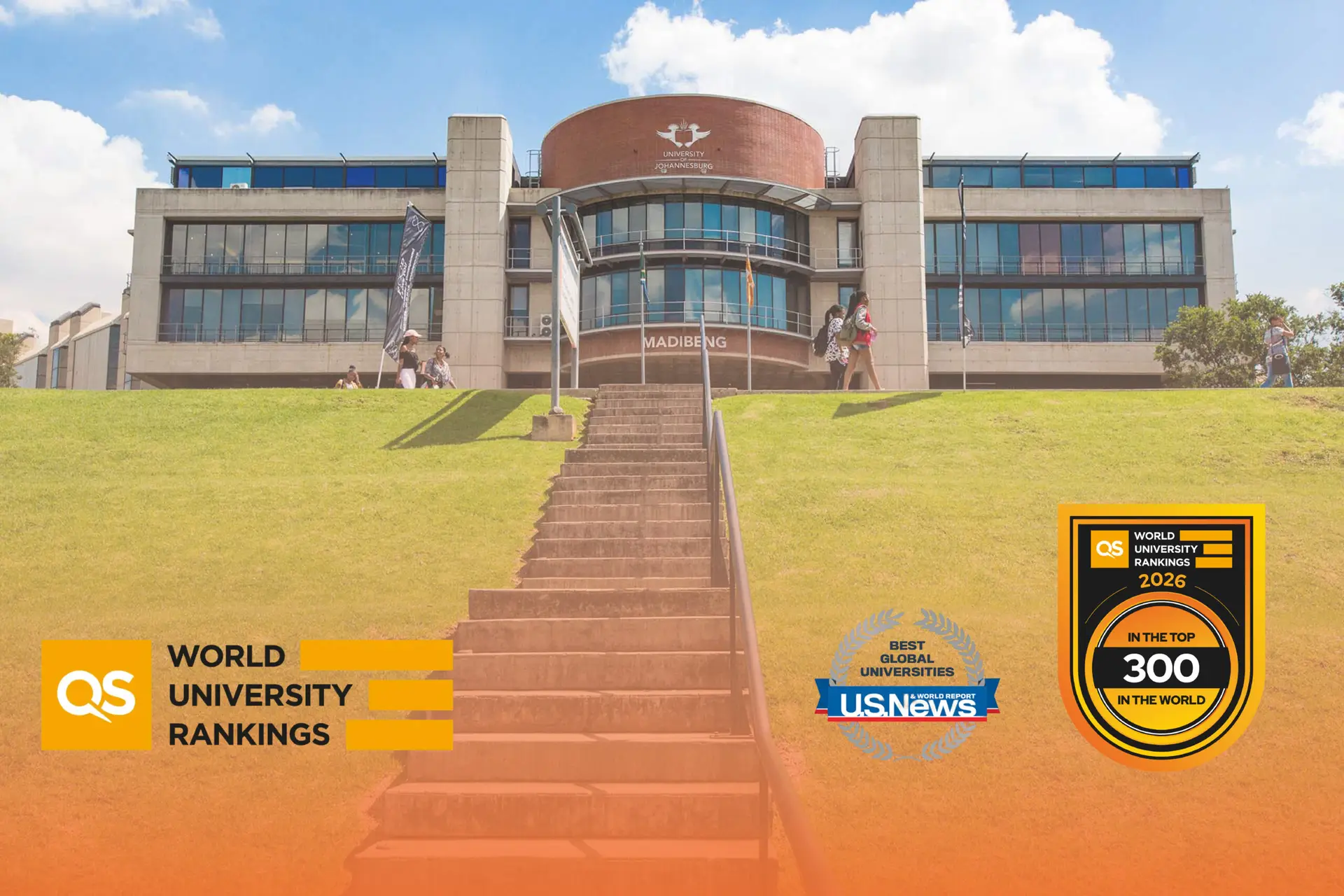
The University of Johannesburg (UJ) has climbed to its highest-ever position in the QS World University Rankings, rising 16 places to #292 globally and securing second place in both South Africa and Africa in the 2027 edition of the rankings released on Thursday, 18 June 2026.
The result marks UJ’s first entry into the global top 300 and continues a sustained upward trajectory that has seen the University strengthen its position among the world’s leading institutions. It also comes as South Africa doubled its representation among the world’s top 300 universities, demonstrating the growing international competitiveness of the country’s higher education sector.
Vice-Chancellor and Principal, Professor Letlhokwa George Mpedi, welcomed the achievement as a significant milestone in UJ’s journey towards global excellence.
“Achieving our highest-ever QS ranking of #292 globally and breaking into the world’s top 300 universities for the first time is a significant milestone for the University. What is particularly encouraging is that this achievement forms part of a broader pattern of progress across multiple international ranking systems, reflecting the strength and consistency of our academic, research and internationalisation efforts. Together, these results affirm UJ’s position as one of Africa’s leading universities and a globally recognised institution committed to excellence, innovation and societal impact.”
The latest achievement reflects years of strategic investment in academic excellence, impactful research, international collaboration and innovation, which continue to strengthen UJ’s global standing and influence. As one of Africa’s leading young universities, UJ has steadily built momentum across major international rankings, reinforcing its position as a globally recognised institution anchored in Africa and the Global South.
A key driver of UJ’s continued ascent is its research excellence. UJ recently retained its position as South Africa’s leading producer of accredited research outputs for a fourth consecutive year, according to the Department of Higher Education and Training’s Sector Report on the Evaluation of the 2024 Universities’ Research Outputs. This sustained research performance continues to strengthen the University’s international standing and contributes significantly to its growing global influence.
Prof Mpedi said the latest rankings also reflected the growing strength of South African universities on the global stage.
“Our rise in both South Africa and Africa demonstrates that UJ continues to strengthen its position among the continent’s leading universities. While this achievement is significant for UJ, it is equally important for South African higher education. The latest rankings see South Africa double its representation among the world’s top 300 universities, highlighting the growing global recognition of the country’s academic and research excellence. UJ is proud to contribute to this national success story and to advancing South Africa’s position as a knowledge-producing nation.”
The latest QS rankings highlight UJ’s exceptional performance in global engagement and international collaboration. The University achieved a score of 99.4 in the International Research Network indicator, ranking #11 globally and #1 in Africa. This indicator measures the diversity and extent of international research collaborations and reflects UJ’s success in building meaningful partnerships that advance knowledge creation and societal impact across borders.
UJ also achieved a score of 99 in the International Faculty indicator, ranking #132 globally and #1 in Africa. In the International Student indicator, the University ranked #408 globally and #1 in Africa, further demonstrating its attractiveness as a destination of choice for talented academics and students from around the world. Together, these results reinforce UJ’s position as one of Africa’s most globally connected universities.
The University’s upward trajectory is also reflected across other major international rankings. Earlier this month, UJ improved its position by 20 places to #587 globally in the 2026 Center for World University Rankings (CWUR), while advancing 38 places to #281 globally in the 2026–2027 U.S. News Best Global Universities Rankings. These achievements further reinforce UJ’s growing international competitiveness and rising global profile.
The University’s growing international stature is equally reflected in its subject rankings performance. In the latest U.S. News Best Global Universities Subject Rankings, UJ was ranked in 24 subjects globally, with 13 subjects ranked #1 in South Africa and four ranked #1 in Africa. These include Social Sciences & Public Health, Green & Sustainable Science & Technology, Economics & Business, and Chemical Engineering, showcasing the breadth and depth of the University’s academic and research strengths.
Prof Mpedi said the UJ’s success was underpinned by a deliberate strategy to build excellence across all aspects of its academic mission.
“Equally important is that this progress is supported by strong performance across critical indicators. Our ranking as the leading university in Africa for International Research Networks, International Faculty and International Students, together with our position as South Africa’s leading producer of accredited research outputs, demonstrates that our progress is broad-based, sustainable and built on a solid foundation of academic excellence.”
“These achievements are further reflected in our strong performance in the Times Higher Education Impact Rankings, the THE Sub-Saharan Africa Rankings and the QS Sub-Saharan Africa Rankings, demonstrating that our influence extends beyond academic excellence to meaningful societal impact and global engagement.”
Prof Mpedi concludes: ” While UJ approaches its third decade, the University remains committed to advancing knowledge, driving innovation and creating sustainable solutions to societal challenges. Through excellence in teaching and learning, impactful research and meaningful partnerships, we will continue to strengthen our contribution to Africa’s development while expanding its influence on the global stage.”