Dear UJ community,
In recent years, I have emphasised the role of artificial intelligence (AI) as a transformative tool that can reshape society, education, and the legal landscape. Last year, as the University of Johannesburg marked its 20th Anniversary, we launched the AI and the Law Institute, a pioneering initiative that positions the University at the forefront of Africa’s legal, ethical, and technological transformation. In April this year, we launched the AI and Law podcast (Beyond the Code: AI and Law), a new podcast series engaging focussing on how to govern AI in a rapidly changing world.
CNBC Africa AI Summit: Shaping Africa’s AI Future
Yesterday, I was again honoured to be among the key speakers at the annual CNBC AI Africa Summit in Sandton, an event which provided a unique platform to engage with the future of AI and its role in building a smarter, more connected world. The event brought together Africa’s leading voices for a high-impact discussion on how AI is reshaping industries, economies, and societies in real time. In particular, the summit highlighted cutting-edge global trends in AI with a Pan-African focus. It sparked meaningful dialogue, drove collaboration, and uncovered opportunities for innovation and investment across Africa and beyond.
I participated in the fireside chat, Beyond Regulation: Governing the Future of AI in Africa, which was moderated by CNBC Africa Editor-in-Chief Godfrey Mutizwa. This was an important discussion because, as AI rapidly reshapes our economies, workplaces and societies, it impacts on how we govern and harness this technology. We explored how Africa’s leading enterprises are embedding AI into strategy, operations, customer engagement, and decision-making — while balancing ethics, governance, workforce transformation, and inclusive growth. It was pleasing to see that UJ had a prominent presence in the exhibition space, providing an opportunity to showcase the University’s research, expertise, innovation and broader work in AI to delegates and key stakeholders. Click here to read more.
Beyond the Code: AI and Law Podcast Episode 8
You will recall that last month, UJ launched the inaugural AI and the Law Conference at Skukuza Safari Lodge in the Kruger National Park, Mpumalanga. Held under the theme Artificial Intelligence and the Law: Advancing the Sustainable Development Goals through Law, Governance and Practice, the conference brought together senior judges, government leaders, legal practitioners, academics and technology experts who examined how AI is reshaping the legal profession and the administration of justice. I am delighted to share that Episode 8 of Beyond the Code: AI and Law will be premiered in the first week of September 2026.
Featuring Professor Tshilidzi Marwala, Rector of the United Nations University and globally renowned AI expert, this episode explores how AI can help protect our wildlife, strengthen law enforcement and address the growing pressures facing conservation. From predictive AI and drone patrols to poaching prevention, climate change and the rights of communities living alongside protected areas, this conversation asks an important question: Can technology help us protect Africa’s natural heritage while ensuring that justice, human rights and human judgment remain at the heart of conservation? Beyond the Code: AI and Law: Episode 8 coming out in September 2026.
Embassy of Haiti to South Africa and UJ host a Public Lecture

On Monday this week, UJ hosted a thought-provoking public lecture on one of the most significant moments in the history of Haiti, a Caribbean country which shares a deep history with Africa because most of its people are descendants of enslaved Africans brought over during the colonial era. The lecture was held in partnership with the Embassy of Haiti, the UJ Faculty of Humanities and the Division for Global Engagement. The lecture forms part of the strategic relationship between UJ and the Embassy of Haiti in South Africa. Ambassador of Haiti in South Africa, His Excellency Mr. Jean Robert Pillard, delivered the lecture, which was held under the theme, Bois Caïman: The Night the World Began to Change.
Although I could not attend because of prior engagements, feedback is that it was a thought-provoking lecture that offered a glimpse into the origins of the Haitian Revolution of 1791 and its enduring significance today. The lecture also highlighted historical and diplomatic ties between Haiti and South Africa. It was also pleasing to know that our students engaged with Ambassador Pillard through probing questions ranging from the two countries’ shared histories and how they could use lessons from the past to solve contemporary challenges. I thank everyone involved in organising such a successful event, especially Professor Kammila Naidoo (Executive Dean: Faculty of Humanities), Prof Bhaso Ndzendze (Senior Director: Division for Global Engagement) and their team members. To read more about this, click here.
Vice-Chancellor Researcher and Supervisor Appreciation
On Tuesday, the University held its third annual Vice-Chancellor Researcher and Supervisor Appreciation award ceremony to celebrate achievements across diverse fields; published outputs, creative outputs, supervisors, rated researchers and prestigious awards. The event, which was hosted at the UJ Arts Centre, honours UJ’s dedicated researchers and supervisors who embody the spirit of excellence that defines the university. This is an important event in our University calendar to celebrate the resilience, mentorship and excellence in research. It acknowledges the role of supervisors as guardian angels who shape not only scholarship but human beings.
It is through our hard work and collective efforts in research that UJ is widely acknowledged as the leading producer of research in South Africa and on the African continent. As I always say, we don’t want UJ to be the best University in the world but that the University should be the best for the world. Drawing on the metaphor of Bill Withers’ Lovely Day, I also reminded the audience that breakthroughs often begin in obscurity but, through persistence, become transformative. Indeed, by fostering an ecosystem of global collaboration, interdisciplinary inquiry, and innovative solutions, UJ continues to position itself as a leading research-intensive institution. You can read more about this here.
Research and Innovation Magazine Women’s Edition

It is with immense pride to announce that the latest edition of the Research and Innovation magazine has been published. This edition shines a spotlight on exceptional women researchers, innovators and scholars across diverse disciplines – science, engineering, technology, education, social sciences, law, arts, humanities, business and economics. Their stories span fields from plant science, geology, health, waste volarisation, alcohol and other drugs to education transformation, public art, water quality, and entrepreneurship. Other areas include digital forensics, cybersecurity, engineering, fuel-cell innovation, AI and African languages, and indigenous knowledge systems.
Together, they demonstrate the critical role of women advancing science and innovation. They bring diverse perspectives that enrich research, strengthen collaboration and drive inclusive solutions to local and global challenges. Beyond their scholarly achievements, women researchers serve as mentors, educators and leaders who inspire future generations. I congratulate Professor Refilwe Phaswana-Mafuya (Deputy Vice-Chancellor: Research and Innovation), her team and everyone who contributed to this outstanding edition. You can read the magazine here.
UJ STEAM EXPO 2026
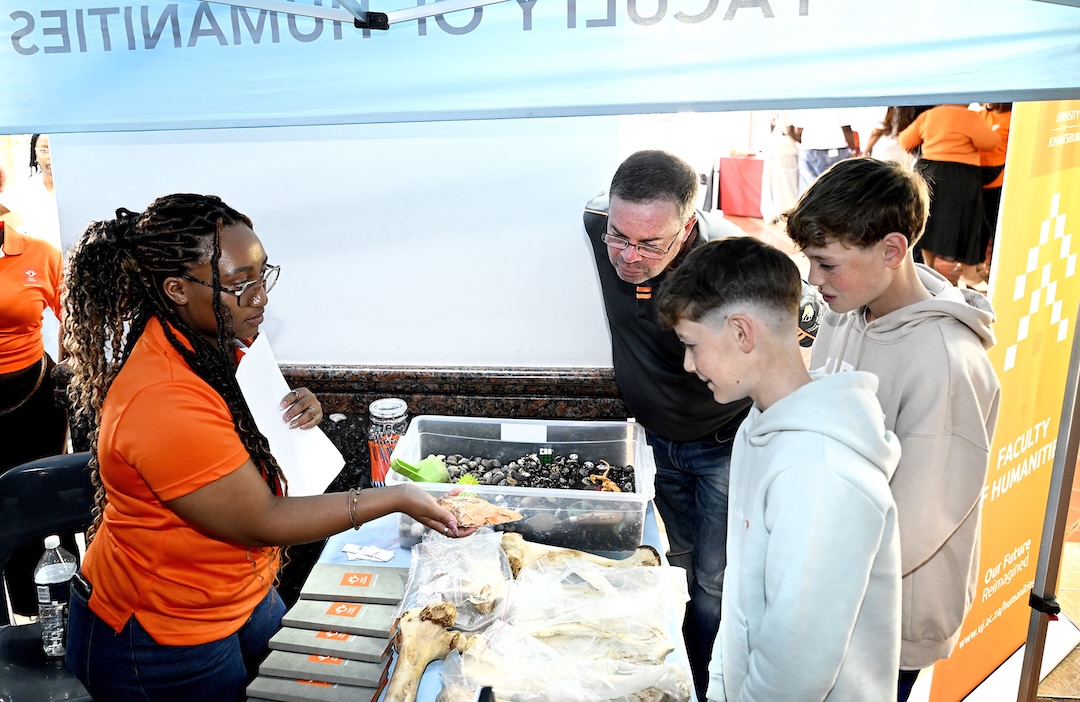
This week, from Wednesday until today, we hosted the second edition of the UJ STEAM EXPO. Launched last year, the event seeks to highlight the importance of Science, Technology, Engineering, Arts, and Mathematics (STEAM) education. The Expo offers learners an opportunity to discover how these fields can inspire innovation, creativity and their future academic and career journeys. It brings together academic entities across the University, as well as learners and teachers in and around Johannesburg, in a dynamic showcase to reignite passion for STEAM in schools, especially in the era of AI and job security. This underlines the University’s continued commitment to prepare the next generation of innovators and problem-solvers.
As with last year, learners explored groundbreaking projects and interactive showcases presented by UJ’s seven faculties, the College of Business and Economics and its Johannesburg Business School (JBS). This includes experiencing a 3D-printed wall, stepping into a virtual reality courtroom, exploring the University’s AI Hub, and learning practical first aid and firsthand the innovative teaching, research, and learning that define UJ. The event aligns strongly with UJ’s Strategic Plan 2035, which sets out a bold vision to position the University as a future-focused, globally. To read more about this, click here.
UJ Launches Rapid Response Board Game
In significant development this week, UJ in collaboration with International Committee of the Red Cross (ICRC), has launched a rapid response board game designed to make International Humanitarian Law (IHL) more accessible, practical and engaging. The Rapid Response: IHL, as the board game is called, has already proved successful, having reached people in 43 countries since its launch on Thursday. It was launched during the SARChI Chair International Law Workshop: All-Africa Workshop on IHL. Developed by UJ Law, the NRF SARChI Chair in International Law (SARCIL) and the ICRC, the board game uses interactive gameplay to help participants understand and apply the rules governing armed conflict. The initiative is aligned with UJ’s 2026 focus on societal impact, demonstrating how the University is translating academic expertise and international partnerships into practical resources with relevance beyond its campuses.

It features a board, playing tokens and 90 cards containing key IHL concepts. Working in teams and against the clock, players have one minute to explain and correctly identify as many concepts as possible before advancing on the board. The fast-paced format encourages knowledge recall, critical thinking, teamwork and discussion, while helping participants engage with humanitarian principles, protections and prohibitions. The game is designed for use beyond the university classroom, professional, humanitarian and civil society training. It is also relevant to those who may need to understand and apply IHL in real time, including military legal advisers and members of armed forces. I congratulate Professor Charles Maimela (Executive Dean: Faculty of Law, UJ) on this exciting development. Click here to read more about this.
Professorial Inauguration
This week, we celebrated one of our academic staff members who has been promoted to a full professor. Please join me in congratulating Professor Mthokozisi Simelane on his professorial inauguration on Wednesday. Prof Simelane and his research group focused on transforming traditional medicinal knowledge into scientifically validated healthcare solutions. They have investigated numerous indigenous medicinal plants with activity against malaria and diabetes, two of the most pressing health challenges facing Africa.
In his speech, Prof Simelane said the most exciting development of his career is establishing an Indigenous Knowledge Innovation Platform in a rural village in KwaZulu-Natal. The village preserves traditional knowledge about a threatened medicinal plant featured in Prof Simelane’s research. I was particularly intrigued by his concluding message, which is that the future of African science will not be defined by the resources we lack, but by the knowledge we value, the partnerships we build, and the courage to transform discovery into lasting impact. Congratulations Prof Simelane, welcome to the elite club in the world of academia! To read more about this, click here.
High Tea With the VC
I thank everyone who attended the special Women’s Month edition of the VC’s High Tea book discussion this past Friday. I hosted Ms Lindiwe Sangweni-Siddo for a discussion of her book, The Syndicate of Twenty-two Natives, a deeply personal memoir, in which she pays tribute to her late father, Professor Stan Sangweni, and tells the story of a remarkable family legacy, one rooted in land, perseverance and the determination to secure a future for generations to come. As usual, it was a riveting discussion on one of the highly respected anti-apartheid activists and a pioneer of public service excellence. Watch this space and our social media platforms for a video link of the discussion.
UJ to Host the Combating Corruption Summit 2026
Corruption, as we know, is a destructive force that robs citizens of their dignity, equal opportunities, and access to essential public services. To create greater awareness of this scourge, UJ will host its third edition of the Combating Corruption Summit next week. Since its launch in 2024, the Combating Corruption Summit has established itself as a leading platform for courageous conversations, innovative thinking, and collective action against one of South Africa’s most persistent challenges. Convened by UJ’s Office of the General Counsel, the Summit brings together influential voices from government, business, academia, law, civil society, and law enforcement who are united in their commitment to advancing integrity, transparency, and accountability.
To be held under the 2026 theme, Taking Action, Ensuring Accountability, this year’s Summit will take place from 2 to 4 September 2026 at the UJ Arts Centre (Keorapetse William Kgositsile Theatre). Delegates will engage with distinguished experts who will share insights on advancing anti-corruption reform, strengthening governance, driving ethical leadership, and building institutions that inspire public trust. More than a conference, the Summit serves as a catalyst for meaningful change. It moves beyond dialogue to promote practical solutions, measurable outcomes, and sustained collaboration among stakeholders committed to combating corruption.
UJ to Host 2026 MTN Media Innovation Summit
Our University, through the Centre for Data and Digital Communications (CDDC), will host the 2026 MTN Media Innovation Summit from Tuesday, 1 to Wednesday, 2 September 2026. The summit is held as part of the MTN Media Innovation Programme, a collaborative initiative involving UJ, MTN and Pan Atlantic University (PAU), Nigeria. The event brings together media professionals, academics, industry leaders and other stakeholders to engage in critical conversations about the role of media in strengthening social cohesion and relations across the African continent.
This year’s event will be held under the theme, Media and Social Cohesion in a Divided World: Spotlighting Nigeria–South Africa Relations. It will explore the relationship between media, society and diplomacy, with a particular focus on Nigeria–South Africa relations. Discussions will consider how journalism and media can contribute to greater understanding between African countries, challenge stereotypes and misconceptions, and promote dialogue in an increasingly fragmented media environment. Former High Commissioner of South Africa to Nigeria, His Excellency. Thamisanqa Mseleku, will deliver the keynote address.
Félicitations UJ Choir

I extend my warmest congratulations to the UJ Choir on its remarkable achievement at the World Symposium on Choral Music in Macau. Selected as one of only 13 participating choirs worldwide, and the only choir representing Africa, our choristers had the distinct honour of opening this prestigious international gathering. This achievement is a source of immense pride for the University of Johannesburg. As a proudly African university, we celebrate the opportunity to share our continent’s rich musical traditions, creativity and talent with audiences from around the world. The choir’s participation also reflects the power of the arts to support quality education, celebrate cultural heritage and build meaningful international partnerships. We congratulate the choristers, Choir Master and UJ Arts and Culture team for flying the flags of UJ, South Africa and the African continent with such distinction.
Celebrating Sport Achievements
It is gratifying to see our sport athletes making us proud through their excellent performance in various sport codes every week. Our para-athletics student-athlete, Puseletso Mabote, reached another career milestone on Sunday evening, 23 August 2026, taking home the prestigious Sportsman of the Year with a Disability award at the South Africa Sport Awards. The student, who runs under the UJ Sports for Students with Disabilities Club banner, continues to captivate global track and field audiences with his explosive performances in the 100m sprint and long jump. At just 20 years, Mabote has already represented South Africa at two Paralympic Games, earned World Championship medals, broken world and continental records, and become a World Champion. Congratulations on this achievement, you have made us proud!
Please also join me in congratulating our ladies’ Netball Team for stellar performances at Stellenbosch University earlier this week. UJ launched their Varsity Netball campaign in electric fashion, securing back-to-back victories with a thrilling 46-39 statement win over the hosts Stellenbosch. Then, they went on court for their second fixture on Monday to hand the newly promoted Central University of Technology (CUT) a convincing 57-36 defeat. Congratulations to Head Coach Bongiwe Msomi and her technical team as well as the players for the great start – let’s keep the same momentum heading into the upcoming games.
Lastly, in an impressive run of positive results, our UJ Senior Men’s Football Team has won their third straight match, after defeating the University of Limpopo 2-0 on Friday, 21 August 2026. This result means that UJ maintain their stay at the summit of the Varsity Football log standings with nine points after Round 3 of the tournament. This evening, they are set to play their fourth clash in a much-anticipated Joburg derby against Wits University on Friday, 28 August.
Kea leboha, ngiyabonga, baie dankie, thank you!
Professor Letlhokwa Mpedi: Vice-Chancellor and Principal
Times mentioned in this newsletter refer to the South African time-zone.