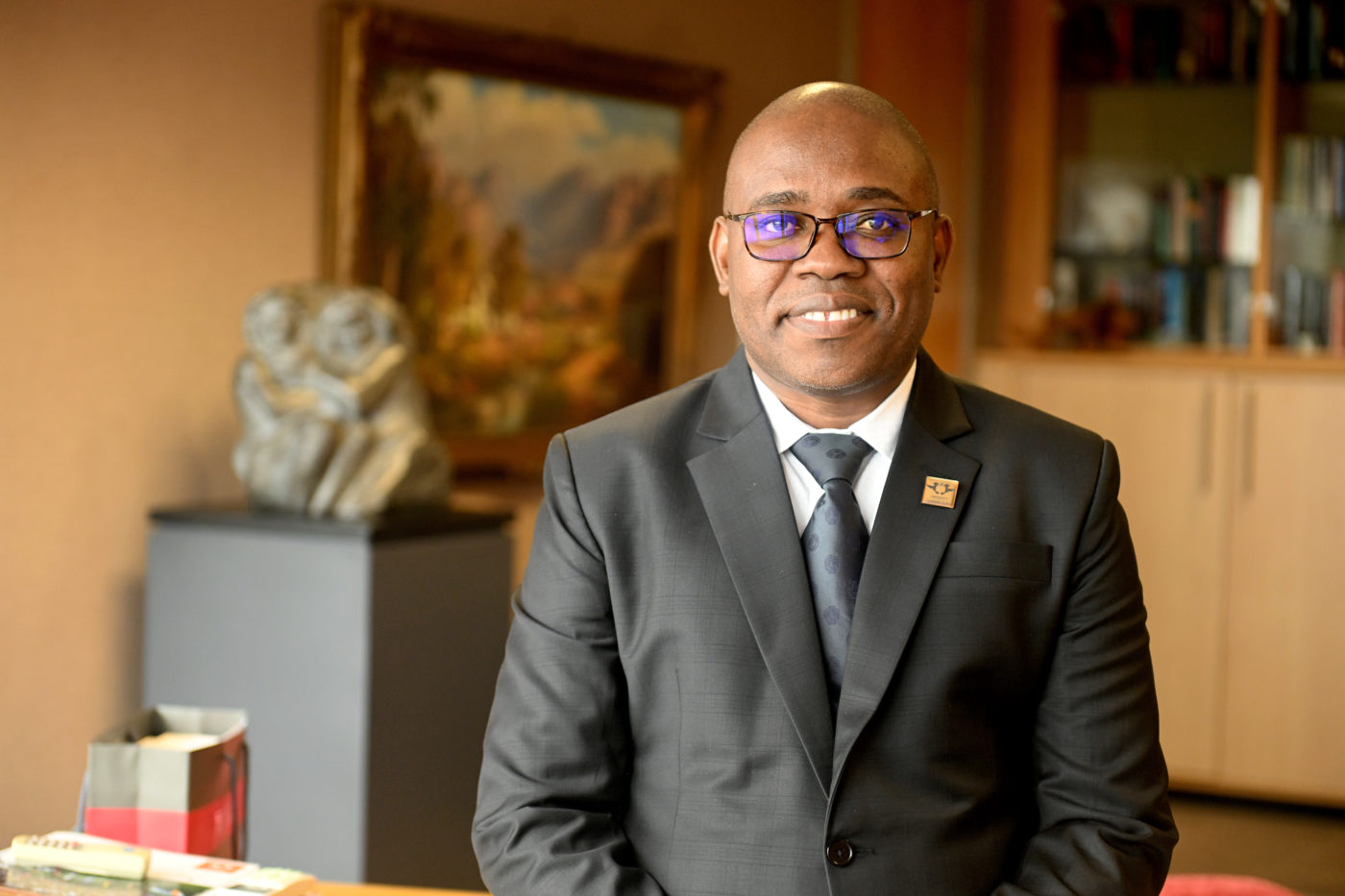
When Professor Chris Schachtebeck delivered his inaugural lecture, “Measuring the Thread: Entrepreneurship, Education and the Long Arc of Academic Becoming”, at the University of Johannesburg, the argument at its centre was both personal and precise.
He placed measurement at the heart of entrepreneurship research: not as a neutral act of recording, but as a decision about what and who is given room to matter.
Drawing on Greek mythology and the figure of Lachesis, Schachtebeck traces fourteen years of research across five phases, each returning to three persistent questions.
In organisations large and small, he argues, one should ask: Who is able to act, where are judgment and courage formed, and how do the measures that institutions choose make it easier or harder to act entrepreneurially..
Prof Schachtebeck serves within the DHET-NRF SARChI Chair in Entrepreneurship Education and the Department of Business Management at the University of Johannesburg.
The work began where Schachtebeck’s own career had: in the corporate world. There, he had watched capable people encounter something more stubborn than simple resistance, organisations that said they valued innovation but made little room for it. That personal frustration became a research question: was this a structural accident, or something more systematic?
His first phase investigated corporate entrepreneurship in small and medium-sized enterprises, and the findings were sobering. “Management support, widely predicted to be the primary driver of entrepreneurial activity, showed disappointingly low levels,” he says.
Organisations claimed entrepreneurial ambition in their strategies, while employees described centralised authority and ideas that circulated without ever being implemented.
The second phase shifted attention to the individual, asking why two people in the same job, with the same title, find very different room to act.
“Opportunity inside organisations is not evenly distributed,” says Schachtebeck. Trust and informal network membership, the research showed, all shape who is allowed to take initiative, regardless of title.
That insight pushed the work toward the classroom. If entrepreneurial capacity is shaped by social permission and informal norms, can it be taught, and what does teaching it require? Research showed that the most effective programmes favour experiential teaching and give students genuine agency over their learning.
“Learning that is consequential is not the same as learning that is assessed,” he says. Programmes too often measure what is easy to count, such as business plan scores, rather than judgment, initiative and ethical awareness.
The fourth phase turned to digital transformation in SMEs, and arrived at an unambiguous result: installing new systems is not the same as digital maturity.
Digital transformation only improved performance where organisations also renewed their culture, structure and strategic direction. “Patience, it turned out, is a strategic variable,” Schachtebeck adds. Across every phase, he says, the technology changes, but the human stakes do not.
The fifth and most recent phase widens the frame to entrepreneurial ecosystems, drawing on Global Entrepreneurship Monitor (GEM) data, to which Schachtebeck has contributed since 2022.
South Africa’s Total Entrepreneurial Activity dropped from a pandemic high of 17.5% to 8.5% in 2022/23, before rebounding to 14.7% in the latest data. But the structural picture is harder to celebrate.
Expert ratings place South Africa near the bottom of middle-income economies across most Entrepreneurial Framework Conditions: 25th of 26 on physical infrastructure, 22nd on the burden of regulation, and 21st on both government entrepreneurial programmes and social and cultural norms. “This is not a failure of individual ambition. It is a failure of the conditions around people,” says Schachtebeck.
What follows is a clear set of implications across teaching, supervision, organisations and policy. For educators, the evidence is consistent: content delivery alone produces weak effects on entrepreneurial orientation. Formation requires exposure to genuine uncertainty, with assessment redesigned to reward judgment and initiative.
For organisations, the gap between rhetoric and reality is rarely closed by strategy documents. Instead, it is closed by clarifying decision rights, protecting early-stage ideas, and rewarding those who reduce barriers for others as much as those who deliver final results.
For policy makers, finance, training and procurement need to be joined up, because a drop in entrepreneurial activity is not a failure of individual ambition, but a failure of the conditions around people. .
Schachtebeck closes by returning to Lachesis. “Professorship is less about personal acclaim and more about stewardship,” he says, “guarding space where careful work can be done, training people who will outgrow you, and using time and position to make room where others can try, fail, recover, and try again.”
Three concerns thread through the research: agency under limits, learning as formation, and time and measure. What we choose to count, and how patient we are willing to be, will determine whose futures we are actually building.
Watch