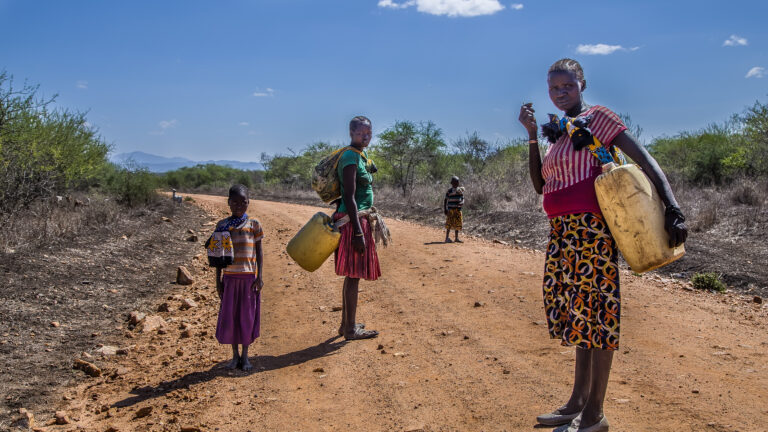
As weather patterns change in sub-Saharan Africa due to climate change, more small farmers watch their crops wither in the fields, wishing for rain, hoping for relief from the looming financial disaster caused by failed harvests. In some areas, irrigation schemes can combat the risk.
However, the decision-making on where to install irrigation needs an urgent overhaul, says Prof Farai Nyabadza from the University of Johannesburg (UJ). “Often the poverty and drought levels of an area are simply added together to decide, but a much more sensitive indicator is needed,” he adds.
Prof Nyabadza is Head of Department at UJ Mathematics and Applied Mathematics.
The study examined 20 years of recent poverty and drought data in Malawi. Severe droughts lasting several years each have plagued the country during this time.
Poverty multiplies the harm
In the study, Prof Nyabadza and Dr Tichaone Chikore decided to multiply drought data with socioeconomic data in Malawi from 2002 to 2022 to better model how drought hits poor farmers harder. Satellite records and World Bank sources provided the information.
“A well-nourished person who breaks a leg, heals eventually because their body is strong enough. A malnourished person with the same injury can face infection and bones that may never reset correctly. They may not be able to work anymore,” explains Dr Chikore.
“The injury is the same, but the outcome is different because poverty multiplies the harm. Drought hitting a community already deep in poverty also multiplies the harm.”
Dr Chikore is a Postdoctoral Research Fellow and lecturer of Mathematics at UJ.
The model shows the country exceeded its critical irrigation threshold for 10 of those twenty-one years, revealing a chronic, near-permanent drought pressure rather than a sequence of isolated disasters.
“When you multiply drought by poverty, you are not measuring two problems at once,” adds Dr Chikore. “You are measuring how poverty makes every drop of rain that doesn’t fall, hit twice as hard.”
Prof Nyabadza frames the connection between rainfall and survival in stark terms. “When there is drought, you have nowhere to go,” he says. “When there is rain, you will always find some alternatives, especially for the poor.”
Narrow rain windows
The study’s quadrant analysis plots each year according to rainfall and poverty levels.
“When there is no crisis, that is the perfect time to implement irrigation,” says Dr Chikore, “so that the pressure is low and there is time, rather than trying to act during an emergency.”
In the 20 years studied, only two years (2010 and 2017) had high rainfall and low poverty.
Looking at the opposite on the spectrum, the years 2020 to 2022 had low rainfall and high poverty, with irrigation needs that exceeded the critical threshold by up to 100%. During the period 2005 to 2010, need exceeded the threshold by up to 25% for several years.
A single bad drought year can trap families in poverty long after rains return, because those who sold assets to survive a failed harvest have nothing left to plant with when conditions improve.
“For farmers, it is entrapment. You are locked into consecutive years of crisis,” says Dr Chikore.
Green poverty
The study’s most counterintuitive finding involves years of adequate rainfall that still recorded high poverty. The researchers call this the Inequity Risk Zone. Rain fell, but communities remained poor, pointing to structural failures including broken markets, absent storage infrastructure, and inequitable land access.
The study’s decision-making framework currently operates at the national level. The next phase of the research will apply the index at district level, starting with Machinga in southern Malawi. In that area, decades of harvest data and contrasting agroclimatic conditions offer a natural experiment.
If that future validation succeeds, the index will be a precision tool that can direct investment in irrigation to the exact places and seasons where compounding crisis is most acute.